
When Dinner Becomes Political
When purchasing power falls, dinner can become political. Germany discovered as much in 2024, after the price of a döner kebab doubled within a few years. This was no joke: even Chancellor Olaf Scholz was asked whether the country’s favourite street food needed a price cap—a Dönerpreisbremse.
The cost of living is politically sensitive, but the döner debate reveals something else: perception matters. People respond not only to official inflation figures, but to the prices they encounter in everyday life.
The Economist tried to give such comparisons a playful yardstick in 1986 with its Big Mac Index. Because the burger is broadly standardised, its local price offers a rough comparison of currencies and purchasing power. Recent figures put a Slovenian Big Mac at about €4.40, or just over $5—cheaper than the American benchmark. Yet a cheaper burger does not automatically mean an easier life: wages, housing and energy costs complicate any simple claim about affordability.
Slovenia’s first McDonald’s opened on Ljubljana’s Čopova Street at the end of 1993. The chain has since grown to 29 restaurants, while Burger King, Subway, KFC and other international brands have appeared mainly in the larger cities. Pizza Hut and Domino’s also tried their luck—a bolder gamble in a region where inexpensive local pizza is woven into everyday food culture. Slovenia, it seems, looked like a market worth testing.
Enter the Big Greasy

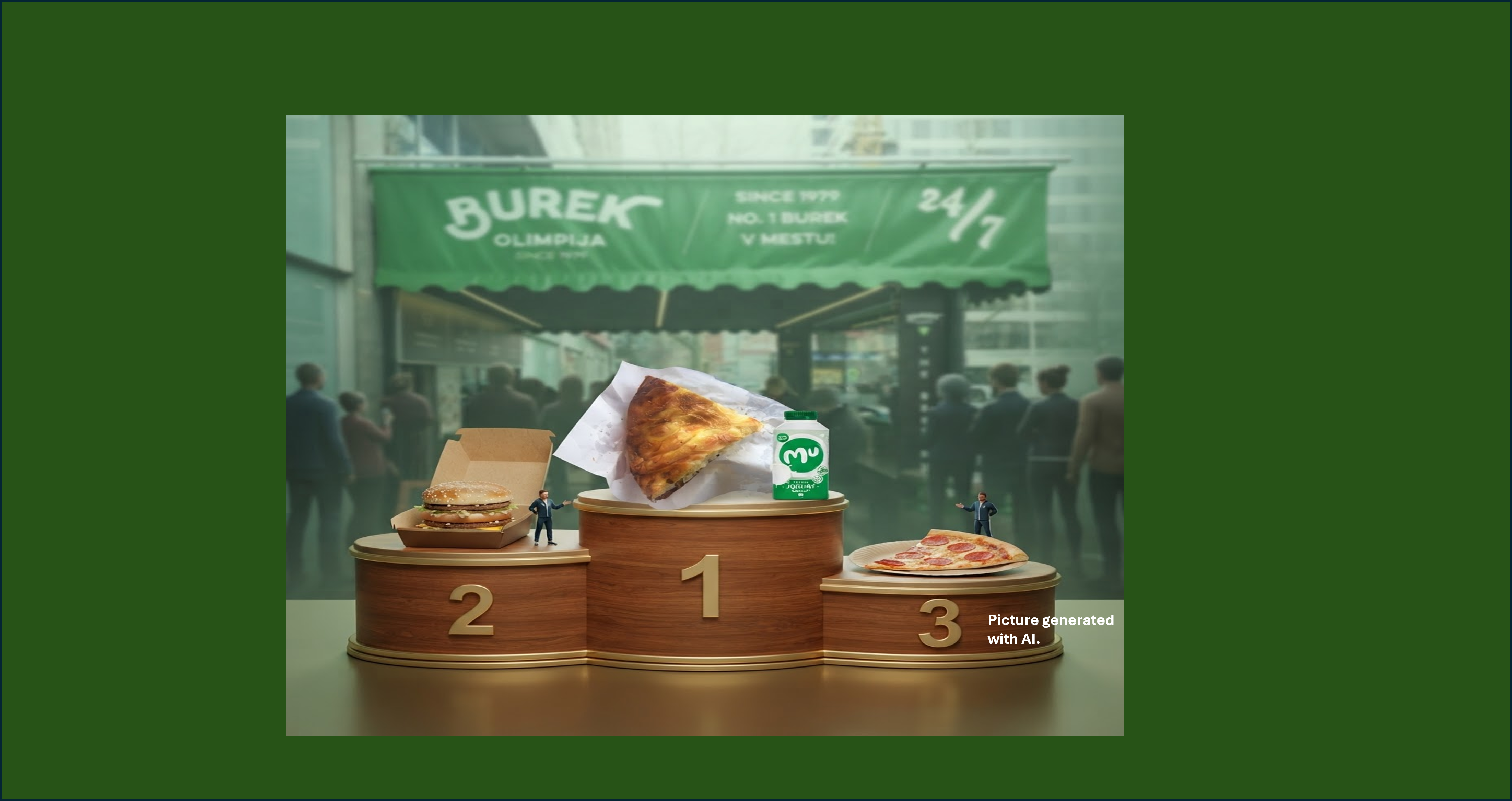
Yet the Big Mac faces serious local competition. Slovenia has home-grown chains such as Hood Burger and Viki Burger, but its true street-food rival is burek. For the uninitiated, burek is a pie of paper-thin pastry wrapped around a savoury filling—usually meat or cheese, although potato, spinach and apple versions are also popular. It is the kind of pastry you can hear before you taste it: crisp outside, rich and yielding within. At roughly €3 to €5, it is cheaper than a Big Mac and, as many Slovenes would insist, far tastier. Burek Olimpija, Ljubljana’s best-known burek shop, says the ideal specimen should be gloriously greasy and washed down with an MU yoghurt drink. The shop has some authority on the subject: since 1979, it says it has sold more than five million bureks.
From bonfire to world cuisine.
Burek’s story reaches much further back, to Turkish nomads who baked yufka dough over a fire and filled it with whatever was available, often meat or cheese. As the Ottoman Empire expanded through migration and conquest, its culinary traditions travelled with it. The name itself is often traced to be derived from the Turkish bürmek, meaning “to twist”—a fitting description of the pastry’s layered dough.
By the 16th century, burek had become a celebrated pastry in Constantinople and at the sultan’s court. Over time, börek-related pastries spread through the vast Ottoman regions in Southern- Europe, North Africa and beyond. Even in Israel, bourekas is an immensely popular snack, which is an “early Spanish relative” of börek, brought along by Sephardic Jewish immigrants.

Centuries of Ottoman expansion also carried burek into the Balkans, and nowhere are the rules stricter than in Bosnia. There, only a meat-filled pastry may be called burek; Bosnians will swiftly remind you that every other filling belongs under the broader name pita.
Burek’s Slovenian chapter began in the 1960s, when workers from other Yugoslav republics brought the dish north with them. There, for a long time, it carried the stigma of being cheap food for immigrants. In the 1980s and 1990s, phrases such as “we wanted workers, but we got burek” and “as simple as a burek” circulated as condescending expressions of nationalist rhetoric.
As fancy as a burek.
That image has changed dramatically. Burek is now especially popular with younger Slovenes, thanks in no small part to Burek Olimpija’s playful digital presence. Through stunts and sharp branding, the shop has recast burek as affordable, modern and unmistakably fun. It has delivered burek by drone, challenged top chefs to create a “Michelin-level” version and introduced hybrids such as pizza burek. The once-dismissed snack now enjoys something close to cult status.
It looks like the burek follows the same path as the German döner. Once introduced by immigrants it nearly became a native part of German food culture, even so much that its price became an item for political debate. Now even Türkiye fears that the döner might become as German as bratwurst.
Such national food concerns are hardly unusual. Yet philosopher Peter Stanković argues that burek reveals something more interesting: the two faces of Slovenia, one traditionalist and the other cosmopolitan. That is what makes the pastry more than a greasy late-night snack. Its price, history and changing status offer a compact portrait of modern Slovenia—international in appetite, protective of tradition and perfectly capable of turning fast food into a debate about identity.
Now that burek has achieved cult status, perhaps it is only a matter of time before McDonald’s localises its Slovenian menu. The chain has experimented elsewhere, from a Nutella Burger in Italy to adding poutine on the Canadian menu. And the ultimate crossover is no longer purely hypothetical: some adventurous cooks have already attempted a Big Mac burek.
Purists, of course, would call that blasphemy. Hands off the Big Greasy.
Leave a Reply