
“Drink more, then you like more”, the waitress at the bar of hotel Union smiled. I had asked for a Coke and she replied, “We have Cockta, it’s better”. It was 2001, my very first night in Slovenia, and obviously I had no clue what she was talking about. But since it sounded like Coca-Cola, we gave it a try. However, it was clearly not love at first sight. She noticed and said: “Maybe beer then?”. She promoted her shop like a pro: “Take Union, much better than Heineken”. At least that was something we could agree on.
Only later did I realize that she had a point. Cockta does not easily compare to “the real thing”. So my “Coca-Cola-conditioned brain” initially shied away. Of course, “taste is personal” but later, at least in my case, practice paid off.
An iconic drink.

So, my next mission was to explore what makes this drink taste so special and how it was created. Cockta turns out to be not just a one-of-a-kind local soft drink. Its history tells a story about national pride, Yugoslav ambition and stylish design and creativity.
The story starts in 1952, when Ivan Due, director of Slovenija Vino, convinced the Yugoslavian regime to create a local substitute for Western carbonated soft drinks; a drink that could compete with Coca-Cola, which was popular but not available.
One of the company’s engineers was Emerik Zelinka. He had already run his family business in liqueurs, wine and fruit juices since 1927 and stayed on board when it was nationalized after WWII. Initially, he participated in the setup of Fructal’s juice production. As he was responsible for promotion and foreign trade, he had frequent contact with Western companies. So, he understood very well that the popularity of Western drinks was not only a matter of taste but also of a well-thought lifestyle campaign and attractive design. It was an experience he brought back to Slovenia and his boss had clearly noticed this.
Zelinka, who was also a chemist, started experimenting as he did not want to simply copy Coca Cola. From the beginning, he eliminated caffeine and orthophosphoric acid. Instead, he focused on local herbs and tried several recipes with caramel syrup, lemon, orange, and cane sugar. But Cockta’s signature taste really emerged when he added rosehip. The result was a drink that people describe as herbal, less sweet but with fruity aromas.
Clever marketing.
Looking for a flashy name, the team initially used brand names like “kokta-kokta” and Yugo Cockta as a subtle reference to Coca-Cola. Soon, the shorter version “Cockta” became the one that stuck. It made Zelinka the father of Cockta (oče Cockte) for generations of Slovenians.
Keeping in mind that marketing would be decisive, Zelinka asked architect Sergej Pavlin to develop a comprehensive campaign focusing on every detail: the design of the bottle, the colors of the trucks, the hostesses’ dresses and the posters with a fancy girl, drawn in modernistic style, sipping Cockta with a straw. The latter was the work of Uroš Vagaja, one of Slovenia’s famous graphic designers. In 2005 Pavlin received the “Timeless Slovenian Design 2005” award for this campaign.
The product launch happened on the 8th of March 1953 at the famous Planica ski-jumping event. Cockta was all over the place and it was an instant success. The day after, the drink was widely known and Yugoslavia had massively fallen for it. In its first year, 4 million bottles were sold; after 10 years that had grown to 71 million, and sales kept rising. Even the introduction of Coca-Cola in 1968 did not seem to affect its popularity.
Cold war cola.
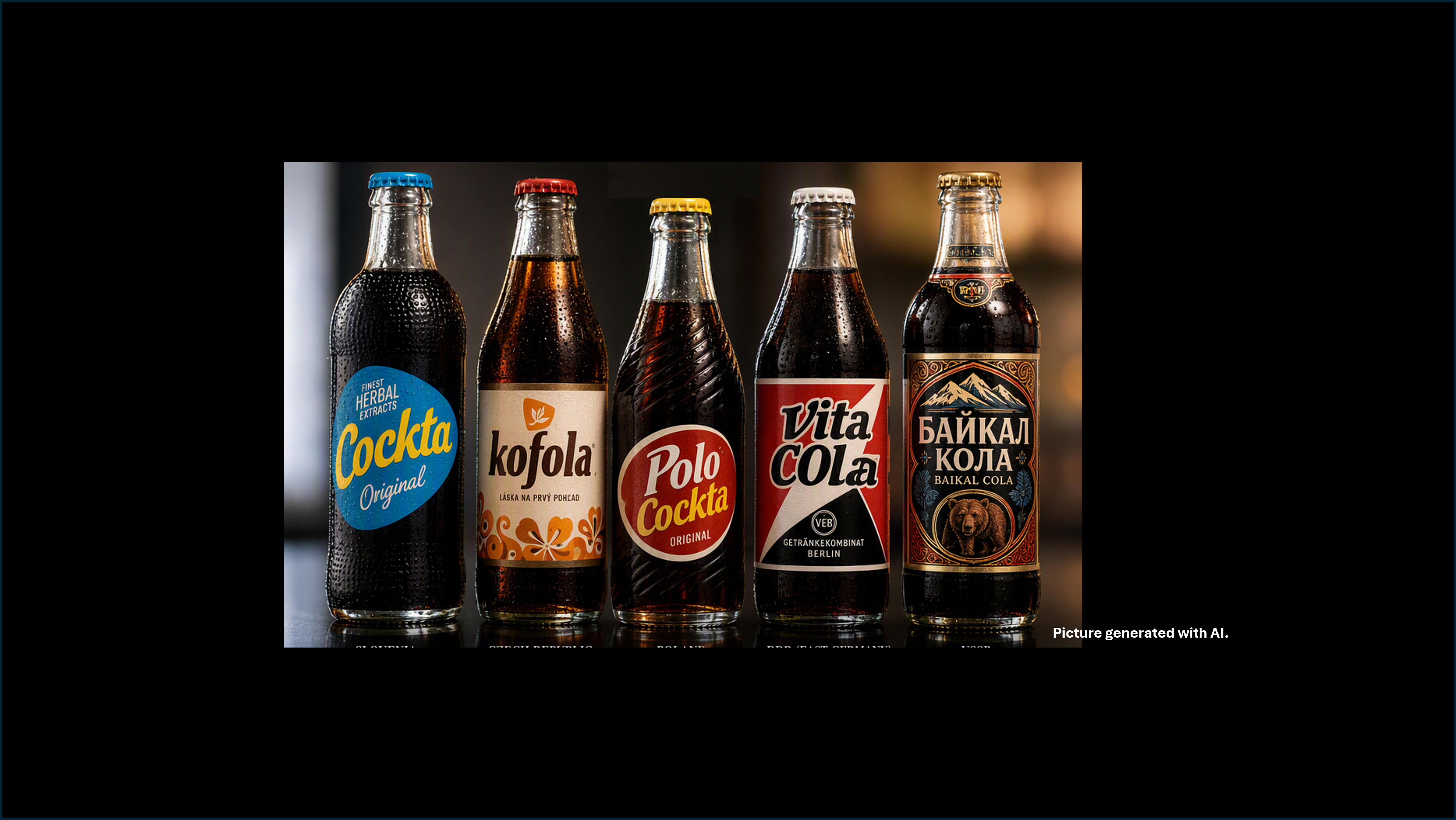
Yugoslavia’s example inspired other Central European countries to follow suit. In the following years, nearly every communist country developed its own homegrown “Cold War cola”.

Former Czechoslovakia put Kofola on the shelves, also based on herbs and fruit extracts but with caffeine. The Soviet Unionhad Baikal with black tea extract, and Siberian ginseng even put forward as an economic priority. The DDR had Vita Cola, quite close to Coca-Cola as it also used cola nuts as basic ingredients. Poland even created a namesake, called Polo-Cockta. Sources say it was initially based on the formula of its Yugo-colleague but later drifted closer to Western beverages. Only the Romanian alternative, called Quick Cola, was not a success. Because of shortage of ingredients, the quality was inconsistent and consumers rated it as overly sweet and flat. But all of the other brands above made their way and stood ground, even when Coca Cola and Pepsi were allowed to enter their markets.
In the early eighties, no less than 37 million litres of Cockta were sold. But after 1991, sales of Cockta declined and for a moment it looked like it had its best times. Yet nostalgia and “consumer ethnocentrism” gave it a second life.

“Old” brands suddenly felt authentic, hip and fashionable again. This social phenomenon is even officially measured on the CETSCALE. For instance, Kofola thrives on a high cetscale-score as it is again very popular and expanding in Czechia and Slovakia. By the way, the Kofola-Hoop holding is also owner of Slovenia’s Radenska.
The choice of a new generation.
Today, Cockta does not have the overwhelming market share of the good old times anymore, but the brand is still very present and an appreciated runner-up. After its owner, Droga Kolinska, was acquired in 2010 by the Croatian Atlantic Grupa, also product innovation and brand restyling efforts increased. Designers introduced a new, fancy bottle and restored the 1953 blue and yellow colors. The offer was expanded with the indispensable Cockta free version while Blondie, an orange drink, filled supermarket shelves. More exotic and fancier new tastes, like black tonic, also respond to changing consumer tastes and needs.
These efforts clearly paid off. Recently, CNN named Cockta one of the notable brand alternatives to Coca-Cola worldwide. And the magazine Monocle called Cockta an “iconic drink” and ranked it at the same level as the Mexican Jarritos or the French Orangina.

Young people have picked up the brand and made it trendy again. Mixed with Slovenian Refošk wine, Cockta has even become a popular long drink amongst students called “bambus”. Consumption, both in Horeca and supermarkets, is on the rise again and exports have increased to more than 20 countries. Of course you can also order it online, but for me Cockta tastes only on its best in Slovenia.
Practice makes perfect.
So, the first thing I do, whenever I am back in Slovenia is to order a good old, ice-cold Cockta. You will agree with me that I really deserve this treat. After all, I had to practice a lot to get to this level of perfection 😊.
You know, at that moment, their slogan was “You Can Never Forget Your First!” It proved to be spot on.
And it seems that the waitress in hotel Union was right after all: “Drink more, then you like more”. Cheers to her!
Leave a Reply