
By the late 1960s, summer holidays had become one of Europe’s middle-class pleasures. The carefree days mattered, of course – but so did the stories brought home. Photo albums, holiday slides and the occasional Super 8 film offered neighbours and relatives a glimpse of easy living on the beaches of Southern Europe.
At the same time, Yugoslavia – hungry for foreign currency – was promoting itself as an affordable alternative to the Italian Riviera and the Spanish costas. Low prices and easy road access gave it a powerful advantage, especially as caravan tourism became the new holiday fashion. From early July onward, Belgian, Dutch and German families began streaming towards the Adriatic coast, their caravans in tow.
Few of those proud owners realised that their journey took them past the birthplace of their beloved “house on wheels.”
Indeed… for more than 60 years, the popular Adria caravans and motorhomes have been manufactured in Novo Mesto, Slovenia. Here’s their story…
Adria, the sidekick…

Adria’s story began modestly in 1960, when the carpentry company Opremales built several commercial “JEMI caravans.” The project caught the attention of IMV (Industrija Motornih Vozil), a manufacturer of DKW-licensed light commercial vans. IMV needed foreign currency to pay for imported components, and a caravan seemed an ideal solution: Western purchasing power was rising, caravan tourism was booming, and the product had clear export potential.
In 1965, Swedish caravan dealer Karl Wilhelm Karlsson showed interest in IMV’s plans. The company handed engineer Martin Sever a daunting assignment: design a caravan for Scandinavia’s harsh climate in time for the 1966 holiday fair in Stockholm. There was just one complication – IMV had never built a caravan. Sever seized the opportunity. He completed the prototype in only two months, leaving no time for testing, then drove it more than 2,000 kilometres to the Swedish capital and arrived just in time. At the exhibition, the gamble paid off: visitors were impressed by how the caravan performed in the Nordic winter.
A rising star…

The response was immediate: IMV received an order for 500 caravans. Sold as the “Adria 375,” the first models introduced the distinctive oval silhouette that would help define the brand. Production began modestly at just two caravans a day, but the range soon expanded with the egg-shaped Opatija and its successors – the 305, 380 and 450 – each offering more equipment and comfort than the last.
Adria quickly earned a reputation for high quality at a keen price, and sales rose steeply. Its caravans offered enough comfort for a family of four while remaining light enough for the modest engines of Europe’s family cars. That mattered particularly in Yugoslavia, where the Zastava Fičko and the Katrca -Renault 4 – were best-sellers. Paired with those cars, the popular Palčica, or “Thumbelina,” was an ideal match.
Smart marketing and fast expansion.
Around 1970, Adria made a brilliant marketing move: it added the famous blue band at window height. Until then, its caravans had been entirely white. The stripe made them instantly recognisable, and Europeans searching for a “house on wheels” began asking dealers simply for “the caravan with the blue line.” A design detail had become a brand signature.
The blue stripe made Adria easy to spot, but the company’s rise was not built on looks alone. During the 1970s, its larger caravans adopted double-glazed windows and warm-water heating – comfort features that helped push the brand towards the top of the European market.
With Scandinavia secured, Adria began winning over the Netherlands, Belgium and Germany. Its characteristic caravans became immensely popular, and the company responded by moving closer to its main markets. It opened a factory in Deinze, Belgium, which grew into the town’s largest employer with as many as 350 employees
The blue band was not Adria’s only enduring visual signature. In 1988, designer Marjan Paternoster created the red emblem that became popularly known as “the snail.” Together, the red icon and Adria blue have shaped the brand’s identity ever since.
Constant innovation assures top sales.

Constantly innovating and investing in new types, Adria was building further on its reputation as a luxurious, sophisticated and very reliable caravan. Consequently, sales grew to an absolute record in 1980 with nearly 27.000 holiday vehicles sold, good for a European market share a bit lower than 12%.
Campervans and motorhomes soon broadened Adria’s range. Adria developed its first motorhome in 1982 under the Adriatik name; after several prototypes, serial production began in February 1986 at the Deinze factory. The first production range comprised two alcove models built on the Fiat Ducato 14.
Difficult times, spectacular recovery and new owners.
In December 1989, IMV was divided into REVOZ, Adria Caravan and TPV. Under Yugoslavia’s system of communist self-management, the workforce had to approve the split by referendum. Adria was now an independent company.
But soon after, the breakup of Yugoslavia brought uncertainty, trade disruption, strikes and finally bankruptcy. In 1996, however, a successor company – Adria Mobil – restarted with a limited number of employees. The brand returned with luxurious new models like the Unica caravan. It remained loyal to its brand promise; reliable while offering better equipment and facilities. The new company rebuilt its sales network and patiently worked its way back to the top with a new management.
Two decades later, Adria Mobil performed well again, but its owner, Protej, was heavily indebted. In 2017, France’s Trigano Group acquired 85% of Protej, while Adria’s management retained the remaining 15%.
The Trigano deal gave Adria access to more than 500 dealers across Europe and extended its presence to over 30 countries. The company also began exploring new holiday formulas, including Adria glamping locations in Bled and Ankaran, as well as sites in Croatia and Italy. Beyond tourism, it raised its profile through sponsorship of the Adria Mobil Cycling Club, which featured prominent Slovenian riders including Primož Roglič and Domen Novak.
A scenic trip.
Today, Adria positions itself as a mid-range holiday vehicle. Balancing price and comfort, its customers get a luxurious package for a modest price and of course without any compromise on its technical reliability.
The most legendary test of an Adria camper covered 66,000 miles – about 106,000 kilometers – on the road. Marianne and Chris Fisher drove their 2005 Fiat Ducato Adria Twin conversion through 29 countries on a journey lasting four and a half years; with another 26,000 miles travelled by sea while the van was shipped between continents, the full route totalled 92,000 miles. They called the vehicle “Trudy.” Although almost 20 years old, it endured freezing temperatures in Yellowstone, tornado warnings, extreme heat in India and precarious mountain roads in Georgia – and kept going.
Securing its place at the top.
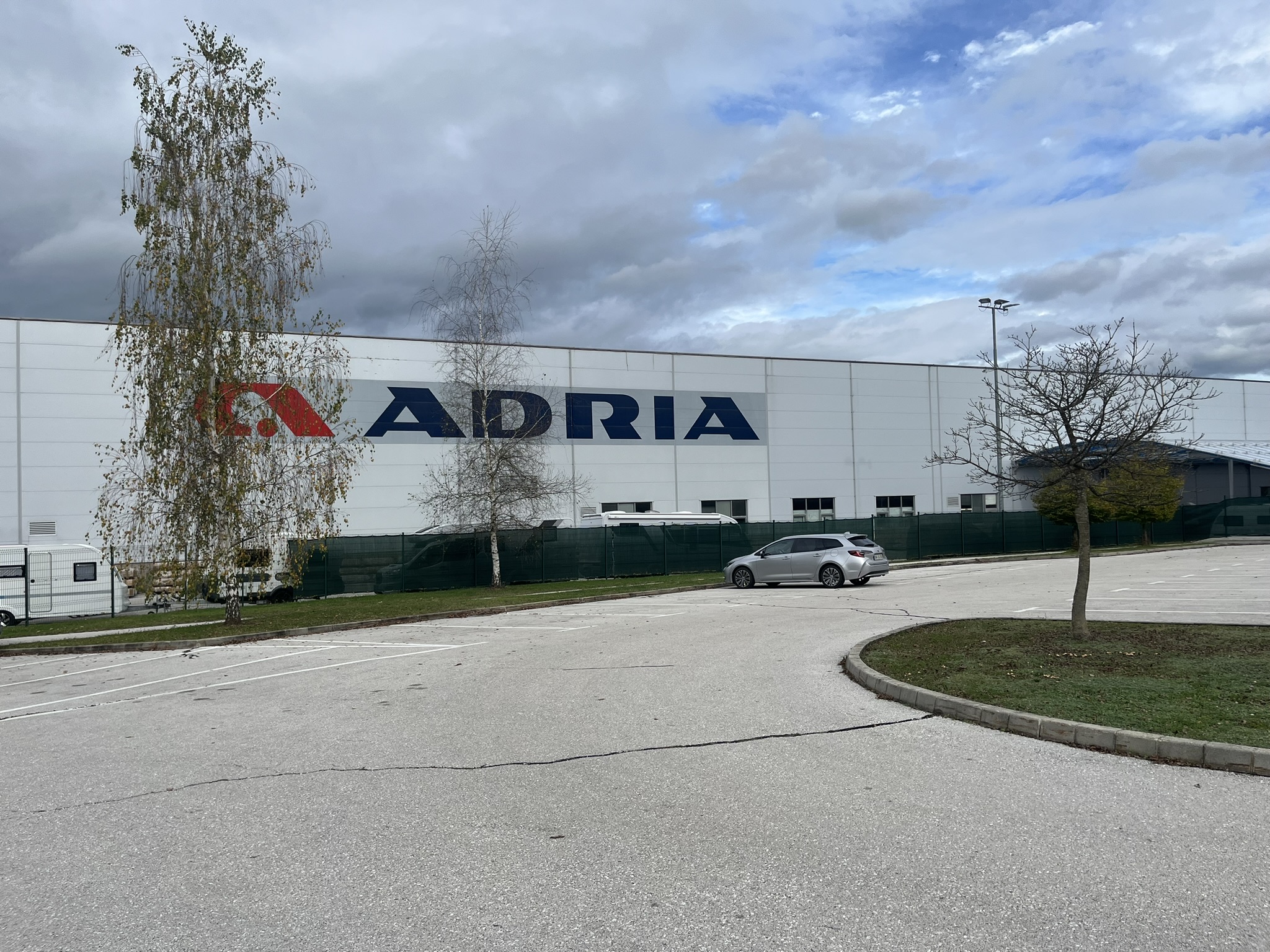
Trigano completed its acquisition of Protej, Adria Group’s parent company, in December 2022. That year Adria reorganised vehicle production at its Novo Mesto complex, whose 147,735-square-metre site includes a production hall of more than 43,000 square metres. It also opened a separate €6 million campervan factory at nearby Bič. Covering 8,500 square metres and designed for annual capacity of 10,000 vehicles, Bič is described by Adria as Europe’s largest dedicated campervan factory.
Caravans and vans remain at the heart of Adria’s business. Since 1965, the company has built more than 725,000 leisure vehicles, the vast majority of them caravans.
Home sweet home …
So logically, whenever we drive towards Slovenia, we pass a lot of proud owners towing their second homes towards another sunny Adriatic holiday.
Perhaps my imagination was running wild, but once I could have sworn I saw an Adria caravan give a tiny jump of joy as it crossed the Slovenian border – happy to be in its “place of birth” again.
And now I think of it… Since caravans and motorhomes are increasingly governed by software and GPS, perhaps Adria could make that little homecoming salute an official Easter egg.
Till the end of 2026 you can visit an exhibition on Adria Mobil in the technology museum of Vrhnika.
IN BLUE AND WHITE: The Phenomenon of the Adria Caravan • TMS – Tehniški muzej Slovenije

Leave a Reply