
February 1947… imagine a room with several uniformed men bent over a map. The blue light pierces through the thick smoke of cigars… Fingers point at locations, trace rivers and mountain ridges. The men frantically draw lines, shake heads, raise their voices. Fists hit the table. Emotions run high… Some leave the room in anger… doors slam. Discussions resume nevertheless, still angry, but they know a compromise has to be made.

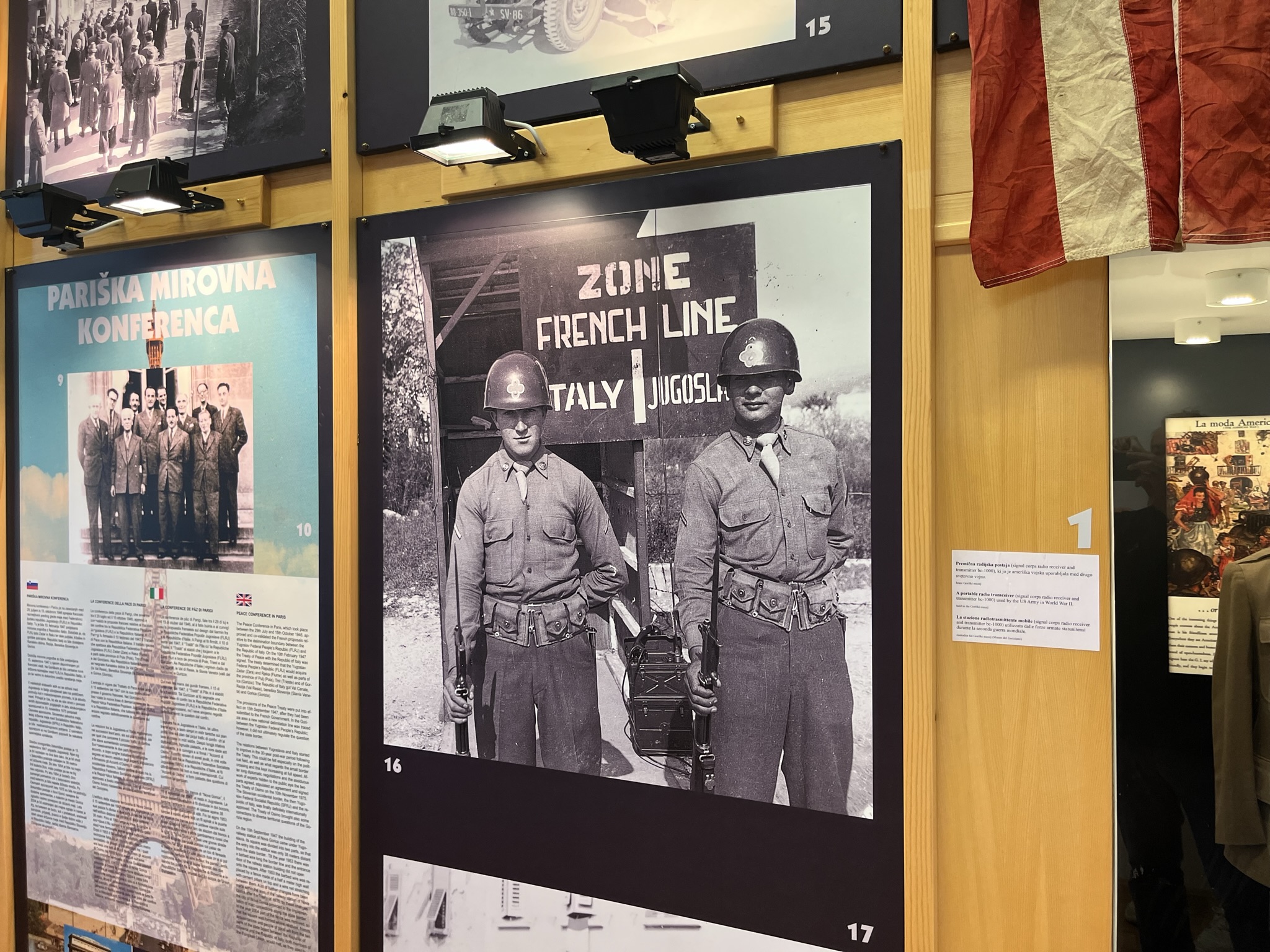
A lot was at stake. The disputed frontier between Italy and the newly created Yugoslavia had always been a fault line between worlds. For centuries, Venetians and Habsburgs fought over the region. Now a new confrontation was taking shape. Western allied forces were standing nose to nose with Tito’s partisans. At stake was again control over a large, disputed and strategic, area. Neither side wanted a new military conflict. Tito was still backed by the Soviet Union, an alliance which would soon start to crumble after the “Informbiro conflict” in 1948. Yet every day the situation became more fragile. A temporary military demarcation known as the Morgan Line kept the peace, but only just. Skirmishes increased, tempers flared and nobody knew how long the uneasy balance could last. Historians would later call it the first indications of the emerging Cold War.
Then, on the 10th of February, despite emotions and tensions, a new border was agreed. After 2 years of uncertainty, people knew which country they belonged to. But it was not a relief for everybody. The compromise focused on strategic positions and economic interests, not on people’s lives and worries.
The line on a map becomes a brutal reality.

Long before the Berlin Wall existed, on the 15th of September this “line” – overnight – brutally separated neighborhoods. Farmers woke up with their fields in another country, families couldn’t visit relatives anymore and friends and neighbors were suddenly confronted with fences and armed guards. The heavily fortified border became one of the earliest constructions of the Iron Curtain which – as Churchill explicitly mentioned in his famous speech at Westminster College – “descended across the Continent from Stettin in the Baltic to Trieste at the Adriatic Sea”.
Surrealistic consequences.
For about 60 years, the border agreed during the Paris Treaty would become a harsh reality and for many people a never-ending nightmare. The few surviving members of the Jewish community, found their synagogue on the Italian side, but access to their ritual graveyard was cut off at the Yugoslavian side.
At the cemetery of Miren, the border ran directly through the graves. In some cases, a person could literally be buried with their head in one country and their feet in another. Relatives were allowed to visit the graves only under strict conditions. It was a scarce moment to communicate with loved ones on the other side – briefly and under surveillance. Eventually the border was adjusted, but for years the situation symbolized the absurdity of political decisions imposed on everyday lives.
Nowhere were the consequences more visible than in Gorizia. Known before the war as the “Austrian Nice”, the elegant town remained Italian. But it lost most of its hinterland. Many ethnic Slovenes were all of a sudden living on the “Italian” side. And on the east side, people in the surrounding Goriška region found themselves cut off from the city that had served as their economic and social center.
Only the beautiful Art Nouveau train station, which was built in 1906, stayed on the Yugoslavian side, with a huge fence right in front of it. And while trains used to connect former Habsburg cities with Jesenice and Trieste, the station had now become a terminus.
Starting from scratch…
In 1947, the communist regime decided to build a whole new city – Nova Gorica – right on the border. Yes, authorities wanted – well-intended – to accommodate the local people. But it was also a huge statement to the West.
Tito wanted to prove his new country was able to realize large and prestigious projects and building a modern city from scratch was such a demonstration. Broad avenues, apartment blocks, public buildings and green spaces would proclaim the promise of a socialist future. Architect Edvard Ravnikar, a student of the famed Jože Plečnik, was tasked with designing the city. Nova Gorica should become a worker’s paradise with decent living conditions, recreation and economic activity.
From all sides of the republic, more than 5,000 brigadiers took part in the construction work. By the beginning of 1950 most of the buildings were finalized, although Ravnikar’s ideas were never fully completed.
A deadly reality.

Yet while the city was rising, the border beside it was hardening. Fences appeared. Barbed wire cut through the landscape. A no-go zone was guarded by watchtowers and patrolling, heavily armed, border soldiers called graničari. They were mostly recruited from other parts of the Republic to avoid collusion. Their task was clear: stop people from crossing, even if that meant shooting at the cost of human life. Especially until 1955, reaching the Italian side was almost impossible. Officially, 31,930 people were captured while trying to cross in that direction, while another 23,123 were caught attempting the opposite route. Around 150 people paid the highest price for reaching out to what they hoped would be a better life. Later, border conditions became more relaxed. Fewer Yugoslav citizens tried to escape, but more and more people from surrounding communist countries tested their luck here. The last person was shot in the Karst region in 1990, one year before Slovenia’s independence.
A walk through history.
The region still keeps this history visible in several museums. In Miren, the museum “Vsemir – border at the graveyard” remembers the people who lost their lives in this neighborhood. In Vrtojba, visitors can climb into a still-intact watchtower. And at the old train station, the border museum displays relics from the eastern side of the frontier and explains how closely it was guarded. Together, these places turn the Cold War border from an abstract line on a map into something painfully concrete.
From 1955 onward, relations between the two sides became a little more relaxed. It was once again possible to “get to the other side”, mostly for economic reasons. But freedom came with conditions: only “reliable” citizens were able to cross, only a few times a month, and only after extensive checks. Out of these restrictions grew a new economic activity: smuggling. Locals still tell the stories with a smile — how they fooled the guards, or simply bribed them, to bring in consumer goods such as coffee and butter. Even “forbidden” devices, like radios able to pick up Western broadcasts, crossed the border. They were hidden in all kinds of places, including under the skirts of an old grandmother on her way to a family visit. For a fascinating glimpse of this endless creativity, visit the museum Na šverc!.
Relaxation.
Over time, Yugoslavia opened up to the West as a holiday destination, and border restrictions softened further. Farmers living close to the border who owned land in Italy could cross already for some time. But over time, people from farther away could also obtain a laissez-passer. Italy became attractive to local men who could earn better wages in Italian factories and bring scarce goods home on the return journey. Despite this relaxation, people were, even in the seventies, still under severe supervision. Stories of youngsters who were sent to re-education camps for listening to Western radio programs are still told today.
By the way, the border crossing went both ways. People from the Italian side, and not only ethnic Slovenes, came to Yugoslavia for medical care. A network of women’s counseling centers was even set up. In a country where Italy’s position on contraception and abortion remained very conservative, many women crossed the border for care and prescriptions.
Relics of a dreadful era.

After the regime change in 1991, crossing the border gradually became normalized again. The iron fences, among the last remnants of the Iron Curtain in Europe, were symbolically dismantled on 20 February 2004. In 2007, when Slovenia joined the Schengen area, border controls disappeared as well. Today, you can walk freely across the shared square in front of the old station, Trg Evrope, from the Slovenian side toward the center of Gorizia. The two cities now revive in each other’s company: many Italians come to Nova Gorica to shop or to try their luck in one of its numerous casinos.
In 2025, both cities became a European Capital of Culture, with events and exhibitions on both sides of the former border. Gradually, the region is beginning to flourish again.
The city of roses.
And you can take that literally: Nova Gorica is known today as the city of roses. The name refers to the noble family von Rosenthal, who lived in nearby Rožna Dolina, the Valley of Roses. Until the Second World War, a horticultural estate was also operated here by the Voigtländer family.
When Nova Gorica was built, this tradition was made visible in the thousands of roses planted between apartment blocks and parks. Today, the city counts more than 12.000 roses, covering a total of 1.900 square meters. Nearby, the Kostanjevica monastery holds one of the world’s largest collections of Bourbon roses. The collection honors the last French Bourbon king, who is buried in this oasis of greenery and peace.
Borderline love.

Apparently, he was not the only famous person who enjoyed this neighborhood. Giacomo Casanova also spent some “quality time” here in 1773. In his memoirs, he wrote that he had found “all the amusements he could desire”. But he had to leave after a confrontation with his host, the count of Torriani, who caught Casanova while he was … well … honoring his reputation with Sgualda, one of the maids.
Who knows, maybe Casanova inspired the people who left a remarkable message in the tunnel under Kostanjevica hill, right on the border. It reads: “Here we have loved each other. You and me. Completely naked”.
One might say that – symbolically – after all these years, love has won over war. However, the message is a bit kinky. So, this case is clearly borderline… 😊.
Visit: The Morgan line memorial

Visit: Border museum Kolodvor at the Nova Gorica station.

Visit: The Kostanjevica monastery

Visit: The remaining watchtower

Leave a Reply