
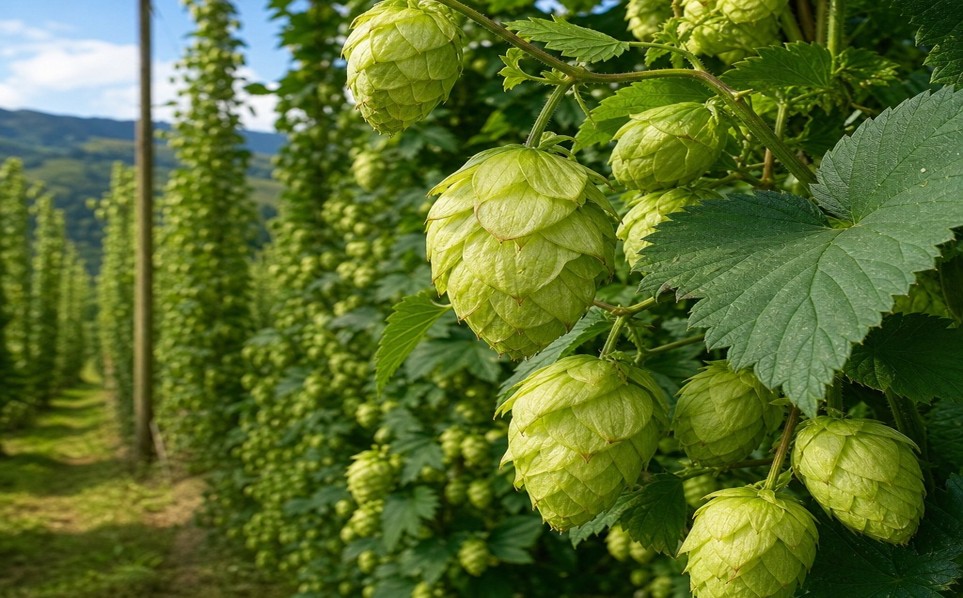

One of the first words visitors to Slovenia tend to learn is pivo. You’ll hear it everywhere, and it pops up across many Slavic languages. Originally, though, Proto‑Slavic pivo didn’t mean “beer” at all; it meant “a drink.” That meaning narrowed around the 12th century, possibly when monks started brewing on a large scale and writing down recipes. In medieval towns, beer was often safer than water: the brewing process killed pathogens, and the low‑alcohol “small beer” stored well for long periods. Preservation improved even more in the 14th century when gruit – a herbal blend – was abandoned to give way to hops (hmelja). Hop-cones, also called “bells,” contain lupulin, prized for its antibacterial power and for the bitterness and aroma it brings to beer. Fun fact: hops are close botanical cousins of cannabis.

The sweet spot.
Hop plants can stay productive for at least 25 years, sometimes even up to 50. Each winter they retreat underground, only to shoot up again in spring (video). But they’re picky: yields swing with the weather, so hops thrive only in a narrow sweet spot of temperate conditions. Northern Slovenia hits it perfectly – long summer days to fuel growth, cold winters to enforce dormancy, and mild temperatures in between.
It started with a mistake.
Slovenia’s hop story starts in 1844, when mostly Bavarian plants went into the ground first. But in the early 1930s, a mildew disease wiped out German stock. Farmers switched to a British variety which was not only resistant but also more yielding. Over time the plants adapted, developing a local signature: softer, earthy, lightly spicy.
Here’s the twist: the imported cuttings were mislabeled. It wasn’t until 20th‑century genetic analysis that the mix‑up became clear. Britain had sent “Fuggle,” not “Golding.” By then, though, the name had stuck, and “Styrian (Štajerska) Golding” was already famous as one of Europe’s most sought‑after hops.
A world class producer.
Slovenia may be small, but in the world of hops it punches well above its weight. The country sits at number six globally. According to 2025 figures of SURS (the statistical office) hops covered 1,609 hectares, yielding about 1.4 tons per hectare on average. Harvest totals shift with every season; 2.200 to 2.800 tons is typical. Yet brewers watch another metric even more closely: the alpha acids that determine how bitter and “powerful” a hop year really is. Slovenian hop growers cultivate over 20 varieties, each adding a distinct note to the country’s brewing identity.
The world’s first beer fountain.

The center of gravity is Žalec, which since 2016 has added a quirky landmark to its hop heritage: the world’s first beer fountain. Visitors purchase a chip‑enabled mug and can sample six beers from automated taps. There’s a catch, though: each tap serves 1 dl, and you can use the mug only once per tap. So it’s about tasting, not a drinking contest 😊. Afterwards, the mug becomes a keepsake and maybe an interesting story to tell. The Green Gold (Zeleno zlato) fountain stands beside the Eco‑Museum of Hop Growing and the Brewing Industry in Slovenia.
The wider heartland is Savinjska—the “Valley of Green Gold.” Slovenia’s own breweries (with Laško as the flagship) process only a small part of what the fields produce. The vast majority is exported, with Germany (37%) as the biggest customer and Belgium (around 8%) in third place. That’s why Slovenian hops feel oddly familiar to Belgian drinkers: Styrian Golding appears in beers like Omer, Duvel, La Chouffe and Chimay Bleue, while Celeia is especially prized in Belgian IPAs.
Know how and innovation.
Styrian Golding is widely known but other traditional names like Bačka, Aurora, Bobek and Celeia also remain widely respected, while newer varieties, developed by the Slovenian Hop Institute in Žalec, are steadily gaining ground. Linked to the institute is an experimental brewery, home of permanent research and innovation on hops and beer brewing.
Today’s brewers are drawn to bold, expressive hops, and Slovenia delivers. Varieties such as Styrian Fox, Wolf and Cardinal have found their way into craft breweries across Europe, while Styrian Dragon has carved out a place in the booming IPA scene.
Much of this success is rooted in science. The Slovenia’s hop institute preserves an extensive gene bank with cultivated varieties and numerous wild hop plants. This highlights the deep botanical history behind a modern industry. Some species originate from the Caucasus which is considered hop’s original habitat. Maintained and refined in Žalec, this living archive keeps innovation alive.
And its influence extends well beyond national borders. Without Slovenia’s expertise, parts of Belgium’s hop heritage might have disappeared entirely.
Saved by the bell.
Once a major hop-growing nation, Belgium has seen its cultivation shrink dramatically. In the late 19th century more than 4.000 ha were covered – good for 2.000 tons of export in 1865. Today all this has been reduced to a limited number of farmers and a modest output, leaving Belgium today with a 22nd place of world production.
As production declined, local hop varieties were gradually replaced by higher-yielding imports, mostly from Germany. Traditional Belgian names such as Green Bell, White Rank and Coigneau disappeared entirely. Not a single plant was found anymore on Belgian soil.
Belgian hop enthusiasts recently scoured the globe for their lost varieties—without success. Then came an unexpected twist. The Slovenian Hop Institute held the key. Back in 1959, it had received Belgian hop cuttings. One single plant was safeguarded for experiments and available in the hops database.
Fast forward to 2013: more than 50 years after disappearing, Green Bell and Coigneau made their way back to Belgium. Today, small quantities are once again available, allowing brewers to recreate Belgian beers that had long since vanished.
Quite literally, saved by the (hop) bell 😊
So perhaps it’s fair to say that Slovenia became the Belgian brewer’s last hope. A perfect excuse to raise a glass – preferably a well‑chilled Belgian Duvel, lifted by Styrian Golding. Na zdravje!
Visit the beer fountain in Žalec.
Leave a Reply