

Last summer, thousands of Citroën old-timers – coming from 42 countries – scrambled in Postojna for the 25th World Meeting of 2CV Friends. The 2CV, or “spaček” as the Slovenes call this remarkable car, was a huge commercial success with more than 5 million sold since its first appearance on the Paris Motor Show in 1948.
With hundreds of buzzing and rattling cars – some of them heavily pimped – and the raw smell of gasoline slowly filling the air, the gathering was an immersive and nostalgic throwback to the 80’s, when I used to drive such car myself.
A homecoming party.

For some of the 2,871 spaček, the reunion was also a homecoming party. Since 1959, around 25,000 spaček cars were assembled in Koper for the Yugoslavian market. In 1972, CIMOS took over production. This was a joint venture between Citroën and two Slovenian state owned companies: Iskra, a manufacturer of automotive components, and Tomos, a legendary local producer of motorized bicycles (Tovarna Motornih koles Sežana).
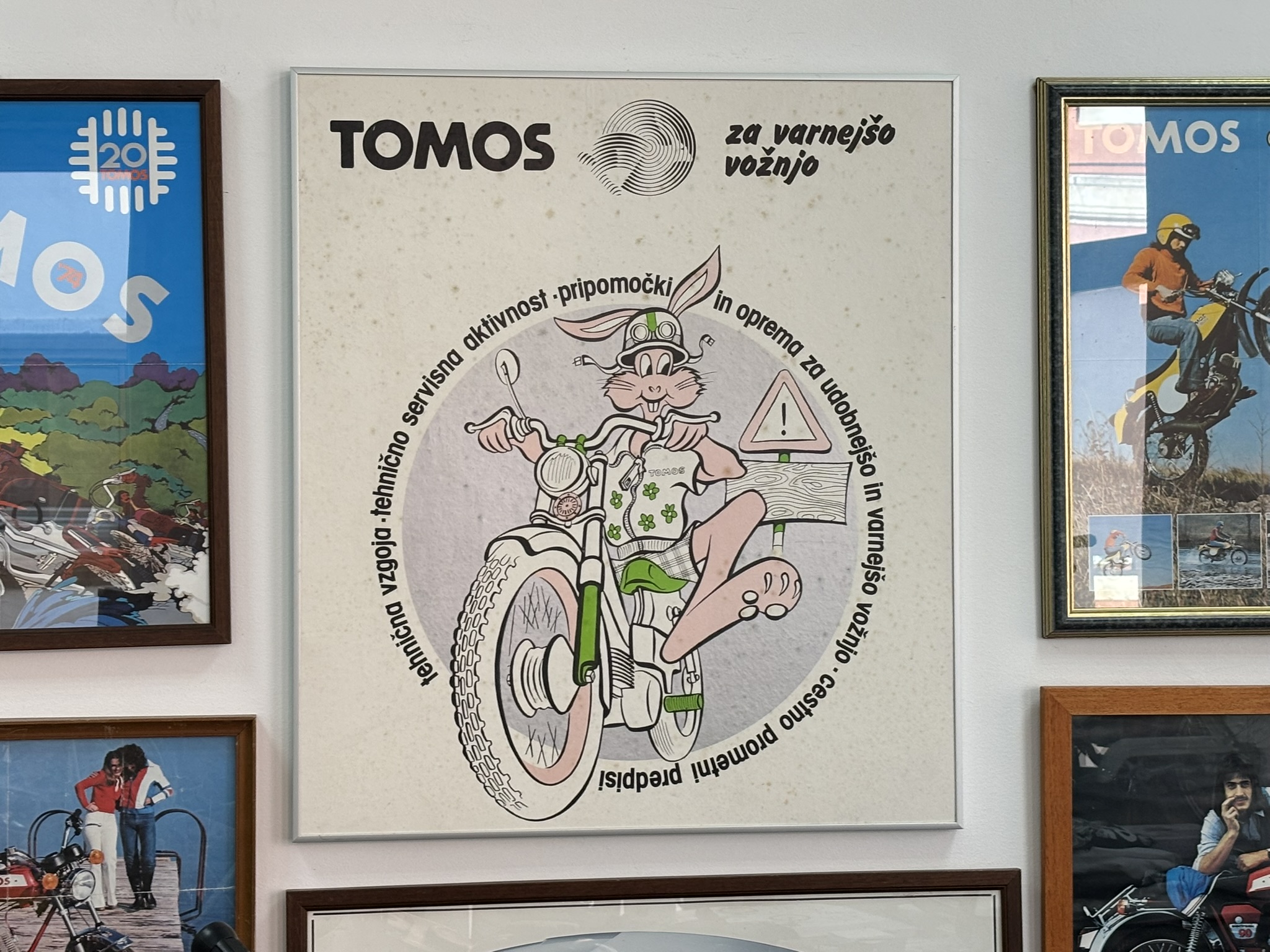
For many Slovenes, seeing or hearing a Tomos moped – a kind of low-speed motorcycle – pass by immediately brings back sweet memories of their youth. This nostalgia extends beyond Slovenia, as Tomos exported and even produced motorcycles abroad, making it a globally recognized brand. Tomos mopeds became cult objects for many generations and an indispensable part of youth identity. Many Slovenes fondly recall riding Tomos mopeds to school or gathering with friends showing off the latest models or impressing their dates.
It’s no surprise that many Tomos enthusiast clubs continue to keep the brand’s memory alive in Sweden, the Netherlands, the UK, and of course, Slovenia. Each year, proud owners of classic Tomos vehicles gather for the ADRIA Classic TOMOS Meeting, a tradition held in Koper. At this year’s event, participants became the stars of a special video clip created for a tribute song called “Tomos Generation.”
An industrial icon.
Tomos was founded in 1954 in Sežana. After relocating production to a factory near Koper, the plant was officially opened in 1959 by Tito as part of his initiative to promote local industrial development independent from the Soviet Union. In its early years, Tomos began with the production of motorcycles. In 1955, Tomos produced 137 motorcycles, 124 scooters, and a number of outboard motors. However, by the beginning of the seventies, the popularity of motorcycles started to wane. Recognizing shifting trends and the growing market for smaller, slower vehicles. In the fifties Tomos had already released the TOMOS Puch SG 250, built under license from the Austrian company Puch, which had been founded by Slovenian-born Johann Puch. Since the model was successful, Tomos decide to focus on the production of mopeds.It turned out to be a golden move.

As production quickly grew, Tomos broadened its offerings including motor pumps, stern engines, saws, and motor-cultivators. The company even manufactured small 4-hp tractors and a children’s car called the Mopi. However, the true flagship product was the moped—a two-stroke 50cc motorcycle. Tomos initially sold 1,712 mopeds, but annual production soon soared to 17,000 units. The first significant export success came in Sweden, marking Tomos’s entry into international markets outside Yugoslavia.
In the mid seventies, Tomos gradually ended its licensing agreement with Puch and began producing its own models, which quickly earned a reputation for reliability. Building on its achievements in Sweden, Tomos expanded exports to Great Britain and Canada in the following years. By 1976, the brand even had a notable market share in the United States. This international growth solidified Tomos’s status as a global player in the moped market.
Perhaps the most remarkable chapter in Tomos’s international story began in the Netherlands. Starting in 1966, Tomos established local production in Epe, which continued until 2009. Recognizing the importance of the Dutch market, Tomos set up its own design team at the plant. To comply with local regulations, they developed a special, slower model known as the “snorfiets,” which became immensely popular among Dutch riders.
As Tomos entered the 1970s, the company adeptly responded to changing times by prioritizing design, comfort, and fuel efficiency—trends heavily influenced by the OPEC oil crisis. To keep pace with these evolving demands, Tomos invested in automatic engines featuring a two-speed transmission system, which simplified riding and improved fuel efficiency for everyday users. These technological advancements meant that, depending on the model, a Tomos moped consumed only between 1.8 and 2.5 liters of gasoline per 100 kilometers, making them exceptionally economical for their era.
An icon of a generation.
In addition to technological advancements, Tomos recognized the importance of appealing design. This led to a collaboration with renowned Italian designer Giorgetto Giugiaro, famous for his work with Ducati and Suzuki. Giugiaro’s contribution resulted in the A5 Colibri, a model celebrated for its clean, efficient, and modern aesthetic—qualities that quickly made it a favorite among riders and contributed to Tomos’s growing reputation.

This combination of advanced technology, stylish design, and practical pricing made Tomos mopeds the preferred choice for personal transportation in the seventies and eighties. While initial prices were relatively high, increased production and expanding exports helped bring the cost down to approximately 1,100 to 1,700 euros in today’s value – about two to three times the average worker’s monthly salary at that time.
No wonder that, during all these years, more than 70 types were developed, with close to 2 million two-wheelers produced.
Made in Slovenia.
Over the decades, Tomos distinguished itself by developing more than 70 distinct models and producing nearly 2 million two-wheelers. However, the beginning of the 1990s marked a pivotal moment. As Yugoslavia disintegrated, Tomos lost its primary market almost overnight, forcing the company to adapt swiftly. Despite this dramatic setback, Tomos managed to survive by shifting its focus toward new markets. As of then Tomos proudly featured the “Made in Slovenia” label, signaling its new identity and independence.
The end of the 1990s ushered in another major transition. In 1998, Tomos was privatized and acquired by Hidria, a move that brought fresh capital and strategic changes. Under Hidria’s ownership, Tomos initially navigated the shifting landscape successfully, responding to tightening environmental regulations and evolving consumer preferences. The company began researching cleaner engine technologies and explored the possibility of electric vehicles, aiming to meet stricter emissions standards and appeal to a new generation of riders. Yet, competition from scooters, rising labor costs, and changing youth tastes gradually undermined sales, particularly as the market for 2-stroke mopeds shrank year after year.
The Dutch connection.
The Dutch factory, established in Epe, had long served as Tomos’s gateway to the largest consumer market outside Slovenia. Its closure in 2009 was a significant blow, eliminating a key export channel and further weakening the company’s financial position. As Tomos struggled to maintain production, Hidria decided to sell the company in 2015. This transition led to a bitter legal dispute with the new owner, Iztok Pikl, culminating in Hidria barring him from using the Tomos brand name.
In the final years, Tomos produced its last mopeds for Pošta Slovenije in 2018. Efforts to refinance the plant and shift toward electric vehicles proved too late to reverse the company’s fortunes. When Tomos could no longer pay its employees, workers turned to the courts, which ultimately declared bankruptcy on January 3, 2019.
Today, Hidria’s Mototec facility in Koper continues to manufacture aluminum frames and parts for BMW, but the once-iconic Tomos brand became a fading memory of Slovenia’s industrial past.
For a time, it seemed that this icon of Slovenian industry had vanished for good, leaving only vivid memories. Yet, in an unforeseen twist, the legendary brand reemerged in its all-time favorite market: The Netherlands. Today, DutchEbike is reviving the Tomos name by selling electric (fat)bikes and small cars, with advertisements that explicitly reference Tomos’s rich tradition in Dutch culture. Who knows—perhaps Tomos will one day return to its “country of birth” in a completely new form?

Fading memories.
Today, electrification has become the new normal – a development that is easy to understand. Electric vehicles are cleaner and, for small vehicles, they are especially practical. Even classic brands like Citroën are rumored to release an electric version of that other icon, the 2CV, in 2028.
As the old Greeks said, “panta rei” – everything flows, and time changes. But with these changes come the loss of certain magic: no more buzzing motors, no more eccentric designs and shiny chrome, no strong smell of burned gasoline.
But unfortunately, also no more goosebumps when a Tomos passes by. The magic has crumbled. I wonder what kind of memories today’s youngsters will share with their children.
Leave a Reply