
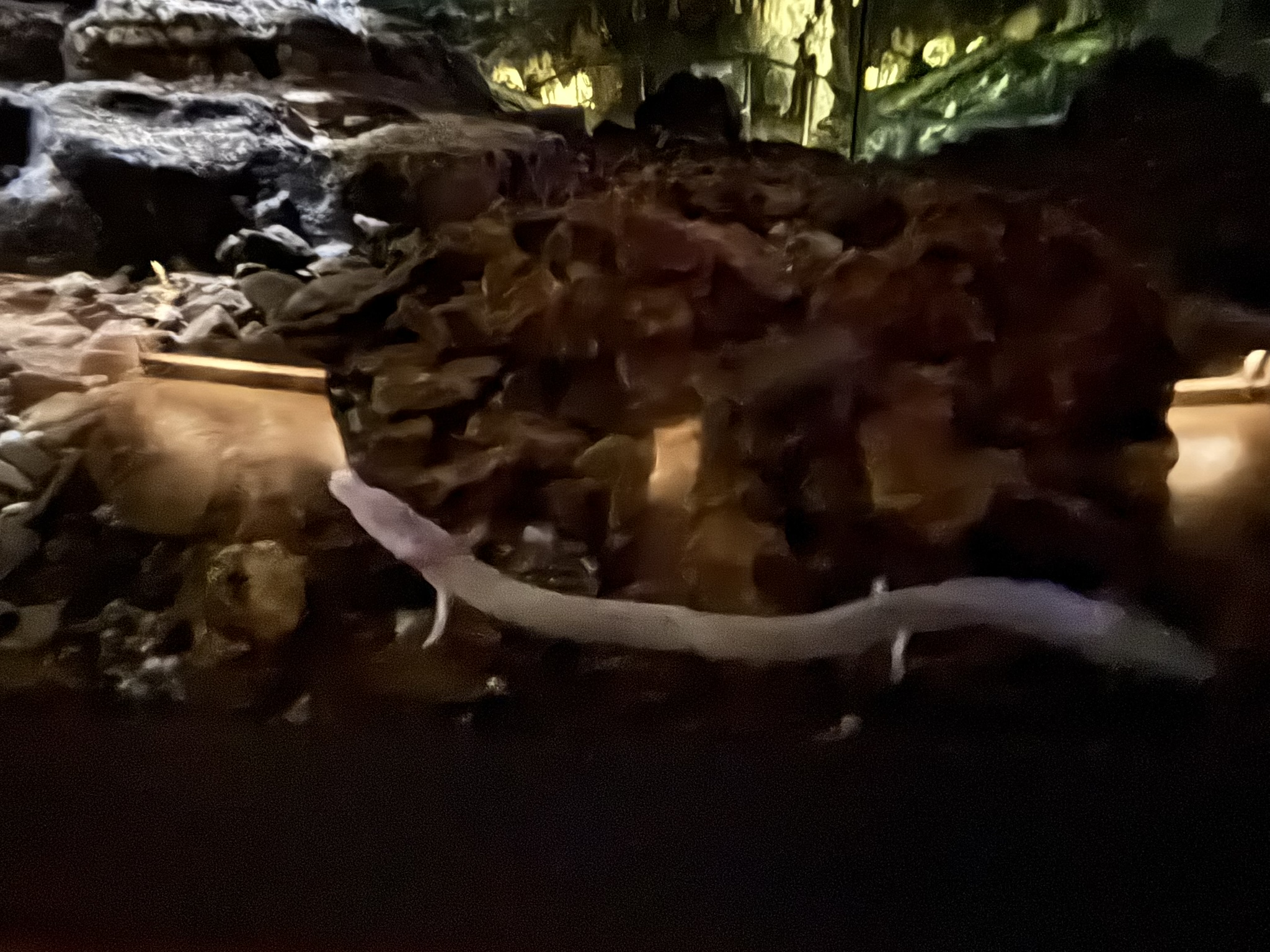

Dragons? Johann Weikhard von Valvasor looked up in disbelief at the local farmers while they were pointing at a pale, tube-shaped animal trying to hide under a rock in the Pivka river. But the locals firmly argued back. After a heavy storm, the valley would always fill with a warm, mysterious mist and the flooded underground cave river would eject these baby dragons in its washing water. So, no doubt, they said. The storm must have awakened a much larger parent lurking inside, probably a descendant of the dragon that Jason and his Argonauts had defeated ages ago when they got stranded in Vrhnika.
The age of science.
Valvasor didn’t believe a word of it. It was the 17th century, and science had begun to overtake superstition. In his famous standard work, The Glory of the Duchy of Carniola (1689), he noted: “Es werden auch bisweilen nach starcken Regengüssen aus der Erden herfür getrieben kleine Thierlein, so die gemeine Leuth vor junge Drachen halten; sie seynd aber nichts anders, als natürliche Thiere.” But even he had to admit… these animals were unlike any other species he had seen before. The creatures looked a bit like a thirty-centimeter long eel, with a human-like, pale and transparent skin. They had legs with three toes at the front and two at the back, no eyes, a flattened snout, and red gills. Truly, they looked like baby dragons.

It still took about 80 years before these mythical animals became classified as olms. In 1768 they got their scientific name by the Viennese doctor Laurenti. But he wrongly attributed them to be surface-dwelling animals. He named the creature “Proteus anguinus” after an ancient Greek water god, living on the island of Pharos. According to Homerus, Proteus was the son of Poseidon, and famous for constant shape-shifting.
But it was the Idrija based Antonio Scopoli, who studied several Proteus specimen, and provided the first scientific description a few years later in 1772. He stated that the animal must have adapted to life in a subterranean environment, an assumption that was only confirmed in 1797, when olms were spotted in the Black Cave – a part of the Postojna Cave System.
The origin of species.
Scopoli enthusiastically sent many specimens for exploration to his naturalist colleagues. As of 1839 about 30 of them were also sent to the Zoological Society of London where Charles Darwin was an active member. Observing this remarkable animal, he referred to it as a support for his view on evolutionary theory. In “On the origin of species”, in chapter 5 (titled Laws of variation) he referred to the Carniolan caves as the habitat of the Proteus and describing them a “wreck of ancient life”.

Olms are indeed considered living fossils, genetically related to their early surface-dwelling ancestors. For tens of millions years they have lived in isolation, experiencing constant water temperatures around 10 degrees, total darkness, and no natural enemies. These unique conditions led to what Darwin described as “reduction of structures through disuse.” For instance, although the olm is born with normal eyes, they soon shrivel and become covered with skin. Additionally, because protective pigmentation was unnecessary in the absence of light, Proteus’s skin became pale pink and transparent.
On the other hand, the Proteus developed a suite of remarkable biological adaptations to survive in the demanding subterranean environment. Underwater, the Proteus breathes through its skin, but he can equally survive a few weeks using his lungs depending on the humidity of the cave’s air. Its sensory abilities are finely tuned for life in complete darkness. The Proteus uses chemical sensors and bioelectric receptors in its skin – much like sharks – to detect prey, and it is believed to navigate using the earth’s magnetic field. These adaptations allow it to precisely locate small crabs, worms, snails, and an occasional tiny fish that got lost into its habitat. Sensitive to environmental changes, the Proteus is spooked by light and noise, making it a challenge for researchers to observe in the wild.
No food… no problem.
One of the most fascinating traits of the Proteus, however, is its ability to enter a state of hibernation. When food is scarce, the Proteus can dramatically slow down its metabolism, surviving without eating for nearly ten years. During this period, it remains almost completely motionless. Some individuals have been observed sitting still for up to seven years, conserving energy until food becomes available. But make no mistake. When prey appears, the Proteus quickly resumes its role as a predator, and takes advantage of rare feeding opportunities.
Equally impressive is the Proteus’s capacity for limb regeneration. This regenerative ability not only helps the Proteus recover from injuries but also contributes to its remarkable longevity. Individuals living for 70 up to 100 or more years are quite common.
Human fish.
Its pale, almost translucent skin inspired its local nickname “human fish” (človeška ribica). But interestingly, in 1986, scientists discovered a darker form of the olm near Črnomelj, living closer to the surface in a tiny region. The species, first famously associated with the Postojna caves, is now known to inhabit hundreds of caves throughout Slovenia, as well as in neighboring Italy, Croatia, Bosnia and Herzegovina, and Montenegro. There is however also a salient story of seven olms which are still at display at the “Olmensee”, an artificial lake in Hermann’s cave in Rübeland (Germany). These olms were unlawfully taken from Postojna when, in 1956, a German geologist – Wolfgang Reichel – tricked the Postojna cave manager with forged paperwork.The theft caused national scandal which reverberated across the former Yugoslavia and the DDR.
Recently, new olm habitats were found in Tabor Ridge near Grosuplje in 2023. Probably more discoveries are to follow. Given the olm’s secretive nature there must still be many more caves where the Proteus is hiding.
Frozen in time.

Ever since the olm became locked in to the Dinaric Karst millions of years ago, it has remained unique to this region as the cave animal doesn’t occur anywhere else in the world. For instance, the mudpuppies of North America likely share a common ancestor with the olm, dating back to the era of the dinosaurs. Another close relative is the axolotl, found in the lakes of Xochimilco near Mexico City. With the Axolot, the Proteus, shares “neoteny”, meaning both species remain “forever young” by retaining their juvenile traits throughout their lives. This perpetual youthfulness is so remarkable that scientists are actively studying the olm’s DNA, which is 15 times longer than the human genome – to unlock the secrets behind its extraordinary biology. It learns us, amongst others, that “the olm” represents not one, but many species descending from several evolutionary lineages.
For ages, it was assumed that life in caves deep underground was not possible. But since the discovery of the Proteus, Postojna is often regarded as the cradle of speleobiology because many other animals were discovered. In 1831, a small “slender-neck” cave beetle was found. Today we know that the cave also houses poisonous cave millipedes, cave shrimps, and bloodcurdling spiders. All of them are troglobites, meaning they have adapted to “the cave life below” with remarkable habits and bodily functions.
But some of them are renowned for bizarre reasons. There is – believe it or not – a beetle called after Hitler, the Anophthalmus hitleri . Discovered in 1933, it is an endangered species for a very unusual reason… Nazi adepts collect them obsessively. Another one, the spineless cave sphaeromatid, is known for a mating ritual which lasts no less than 2 months. I suggest we also study the DNA of this “Casanova of the caves” carefully 🙂 .
A struggle to survive.
Although the olm was officially protected in 1922, enforcement was weak, and locals continued to sell them as souvenirs in glass jars until stricter regulations were implemented in 1980. For decades, olms were even occasionally sold as scientific study object, collectors item or even at the fish markets of Trieste. Today, olms are on Slovenia’s Red list, as an endangered species. They require extremely clean water to survive and that has become increasingly problematic. The challenges of intensive agriculture (nitrate infiltration and pesticides), industrialization (pollution) and climate change have made its survival increasingly problematic, prompting the need for strict protective measures. David Attenborough’s selection of the olm for his personal ark in 2012 brought international attention to its plight. More recently, the Proteus featured as the protagonist in a Brazilian animated children’s film focused on environmental protection, further raising awareness among young audiences.
Woman of the year.

But there’s a silver lining in the cave. Olms can reproduce in captivity, a feat first accomplished in a French experiment way back in 1950. However, it’s hardly a walk in the park (or cave, in this case). Successful reproduction proved elusive for decades. It was not until 2016 that, for the first time in Slovenia, a female olm successfully laid eggs in an aquarium. This was a breakthrough because, unlike previous attempts, the conditions finally mimicked the olm’s subterranean home closely enough for her to feel comfortable.
The excitement was so intense that some folks even suggested naming the olm “Slovenian Woman of the Year”.
The excitement grew even further when, four months later, captured by infrared cameras , the first “human fish” was born, swiftly followed by another 21 siblings. To put this in perspective, female olms lay eggs only about once every 12.5 years, so it’s no wonder that even the BBC and CNN covered this extraordinary event – one that luckily happened again in 2022.
A remarkable coincidence.
And the story doesn’t stop there. National Geographic dedicated an article to the event under the title “the real house of dragons,” playfully tying Slovenia’s ancient dragon legends to these modern-day cave dwellers.
Indeed, one has to wonder … was it really a coincidence that brought this mythical lookalike to settle right here, “in the land of the dragon”? And, you never know … even while the olm is not a dragon… Somewhere deep underground a real one might still be looming. And, if not in Postojna, there is still the Lintvern from Žiri.
Leave a Reply