
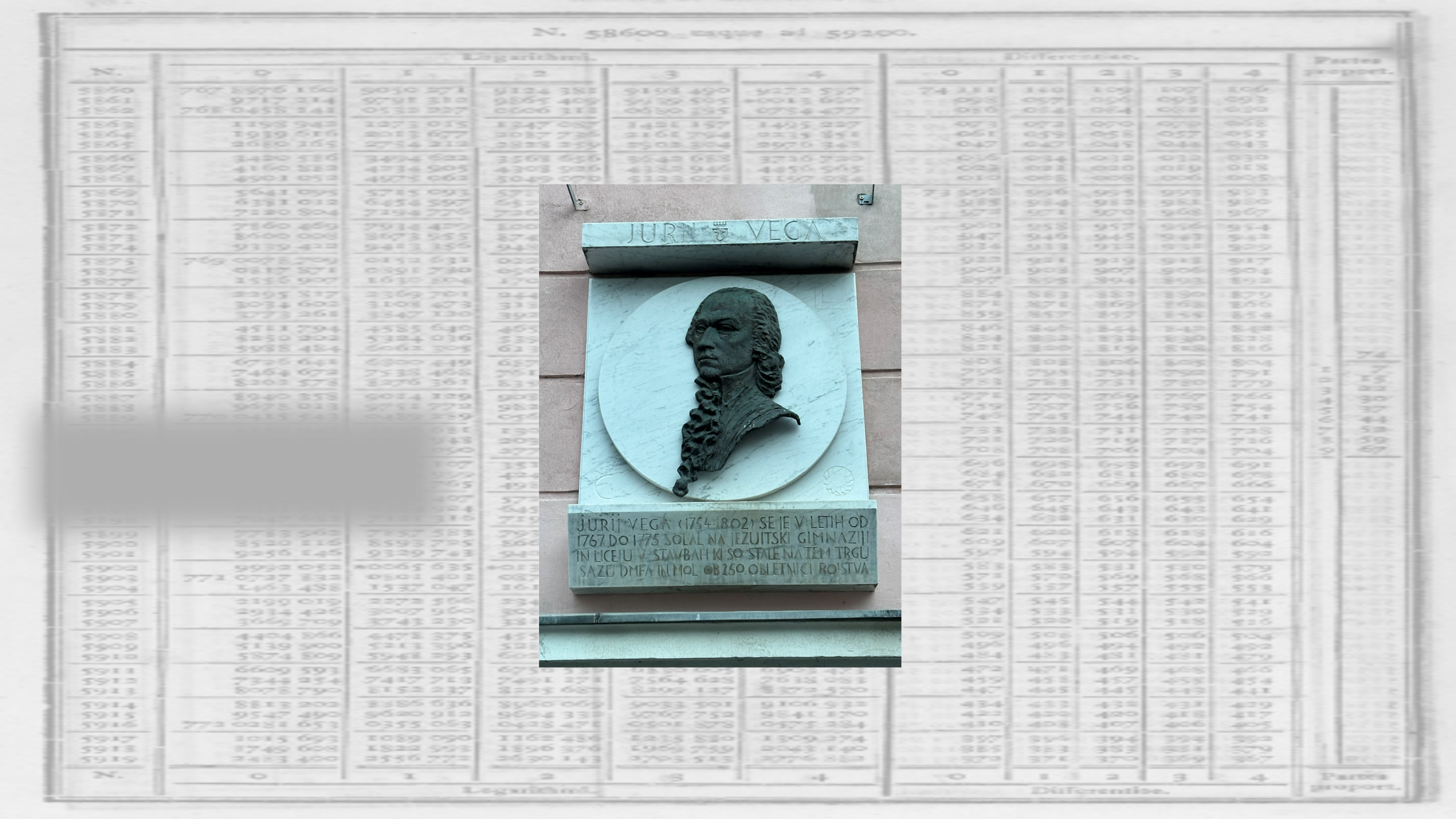

I’ll admit it: I absolutely hated logarithmic tables back in school during the seventies. Calculators were already much faster and easier to use, but our teachers insisted we avoid them. They warned us that calculators would make us brainless and lazy. According to them, math had to be learned the hard way. Only then could we become credible engineers or bankers. And since teachers were always right back then, we didn’t argue.

At my school, it often felt as though time had stood still since the 18th century. That was when Slovenia’s most talented mathematician, Jurij Vega, published his notable work, “ Thesaurus logarithmorum completus .” This book was a remarkable improvement on the logarithmic tables of Dutch scientist Adriaan Vlacq. Released in 1794, Vega’s reference became an essential tool for anyone working in fields that required complex calculations. The book was so successful that its 100th edition was still being printed in 1970 even for Flemish schools. These were the very same logarithmic tables I struggled with in high school.
Deadly effective.
For Vega himself, his logarithmic tables proved to be, literally, deadly effective. As an army officer, he applied his mathematical skills to warfare when he documented his findings in the manual called “ Praktische Anweisung zum Bombenwerfen .” In the 18th century, artillery heavily relied on mathematics to calculate charges and elevation angles for large mortars. By using logarithmic tables, Vega enabled artillery units to fire mortars at much greater distances than previously possible, effectively doubling their firing range up to 3,000 meters. This advancement was decisive during the 1789 capture of Belgrade, which was occupied by the Ottoman army. Being an officer during the Austrian siege, Vega continuously improved his calculations amid the battle, with cannonballs flying overhead. He even rewarded fellow soldiers for their assistance or for finding any mistakes in his tables. For his bravery and leadership in that battle, Vega received the Order of Maria Theresia, which was the highest military honor in the Habsburg monarchy. In 1796, he was knighted, and in 1800 raised to Baron Jurij Bartolomej Vega, or Georg Freiherr von Vega in German as he was called back then.

From zero to hero.
Not bad at all for a kid born poor in 1754 in Zagorica pri Dolskem, a small Slovenian town. Vega’s father, Jernej Veha, was a farmer who died when Vega was only six years old. Despite this early hardship, Vega excelled in his studies at the nearby school in Moravče. Recognizing his exceptional talent for mathematics, his teachers selected him in 1767 to attend the Jezuit grammar school in Ljubljana. After graduating in 1772, Vega came under the influence of important educators like Gabriel Gruber and his assistant Joseph von Maffei, who further nurtured his mathematical abilities.
After completing his studies, Vega briefly worked as a navigational engineer. By 1780, he had moved to Vienna and volunteered for military service, where he joined the artillery department. His aptitude for mathematics and engineering enabled him to quickly rise through the ranks, eventually achieving the position of Lieutenant Colonel.
Alongside his military career, Vega authored several scientific papers and taught at the Artillery School in Vienna. He had a passion for practical applications of mathematics, as demonstrated by his innovations in the army. For example, he improved the mechanisms of pendulum clocks, contributing to advancements in timekeeping technology – an essential development for navigation and scientific measurement at the time.
In 1782, Vega published his seminal work “Rechenkunst und Algebra,” with a print run of 1,500 copies. He also engaged with the work of other mathematicians, such as British professor John Machin, who had calculated pi to 100 decimals. Vega’s own calculation to 140 decimals in 1789 was a remarkable achievement for its time, holding the world record for 52 years. The significance of Vega’s work is underscored by the fact that many prominent mathematicians relied on it. Carl Friedrich Gauss relied on his tables and publications for his own astronomical discoveries even though he also criticized him on some marginal mistakes, and Charles Babbage, known as the father of “modern” computing, also drew upon Vega’s thesaurus for support.
From simple math to supercomputers.
So when, in April 2021, the Institute of Information Science (IZUM) in Maribor, installed the first Euro High Performance Computer it was a no-brainer to find a suitable name.
The VEGA supercomputer, currently performs at over 6.8 petaflops – that’s 6.8 million billion calculations every second. And this phenomenal computing power doesn’t stop there. A major upgrade is planned for June 2026, which will increase its potential by a factor of sixteen, pushing VEGA’s capacity well beyond 100 petaflops. While the worlds fastest computer today already reaches 1.8 exaflops (1800 petaflops) the VEGA computer is still ranked among the world’s top 50. VEGA plays a vital role in supporting Europe’s advanced scientific research, including calculations for CERN, as well as pioneering work in artificial intelligence and biomedicine.
The VEGA computer is not the only contemporary tribute to Slovenia’s most renown mathematician.

His portrait is featured on the Slovenian pre-Euro 50 Tolar banknote, a referral to his influence on astronomy, and his legacy is further honored on several commemorative coins and stamps. In addition, Vega’s name was given to a crater on the Moon and to asteroid 14966 Jurijvega, which orbits the Sun between Mars and Jupiter. March 23, Vega’s birthday, is celebrated as the “Day of the Slovenian Artillery,” recognizing his notable achievements in military science.

A dramatic twist of fate.
Unfortunately Vega died young, at age of 48. His body was found on the 26th 1802 in the Danube at Nußdorf, in very unclear circumstances. Official investigation classified his death as suicide, linked to the recent death of his wife and daughter. However violent murder seems to be more likely as his body was tied to a stake with a strong rope. Later a nearby miller was convicted, said to have killed Vega for his belongings. But yet another theory states that Vega, although celebrated and respected, also had powerful enemies in Austria’s highest ranks. Despite the fact that he served in several battles against the French, his friendship with important French scientists and his advocacy to introduce the French decimal metric system were deemed by some to be high-treason. Ironically, the system was after all introduced later under Franz Josef I in 1871.
Some 224 years after Vega’s death, logarithmic tables have become a historical artifact. Unless his asteroid would hit earth, we will never need them anymore as modern computers are finally doing the hard math work for us.
Brain rot.
So, did my teachers prove to be wrong ? After all, calculators and computers did not turn us into brainless zombies, even though the Oxford word of the Year 2024 turned out to be “brain rot”. But since recently Pope Leo XIV urged priests not to use AI to write their homilies because “the brain needs to be used and exercised” we can only conclude that our teachers were more visionary then we thought. After all the Pope is infallible… not even a million exaflops can beat him.
Leave a Reply