
One of the most scenic trips in Slovenia is over its highest road: the Vršič Pass named after a nearby mountain, literally meaning ‘little peak’
Carved by violent forces of nature…
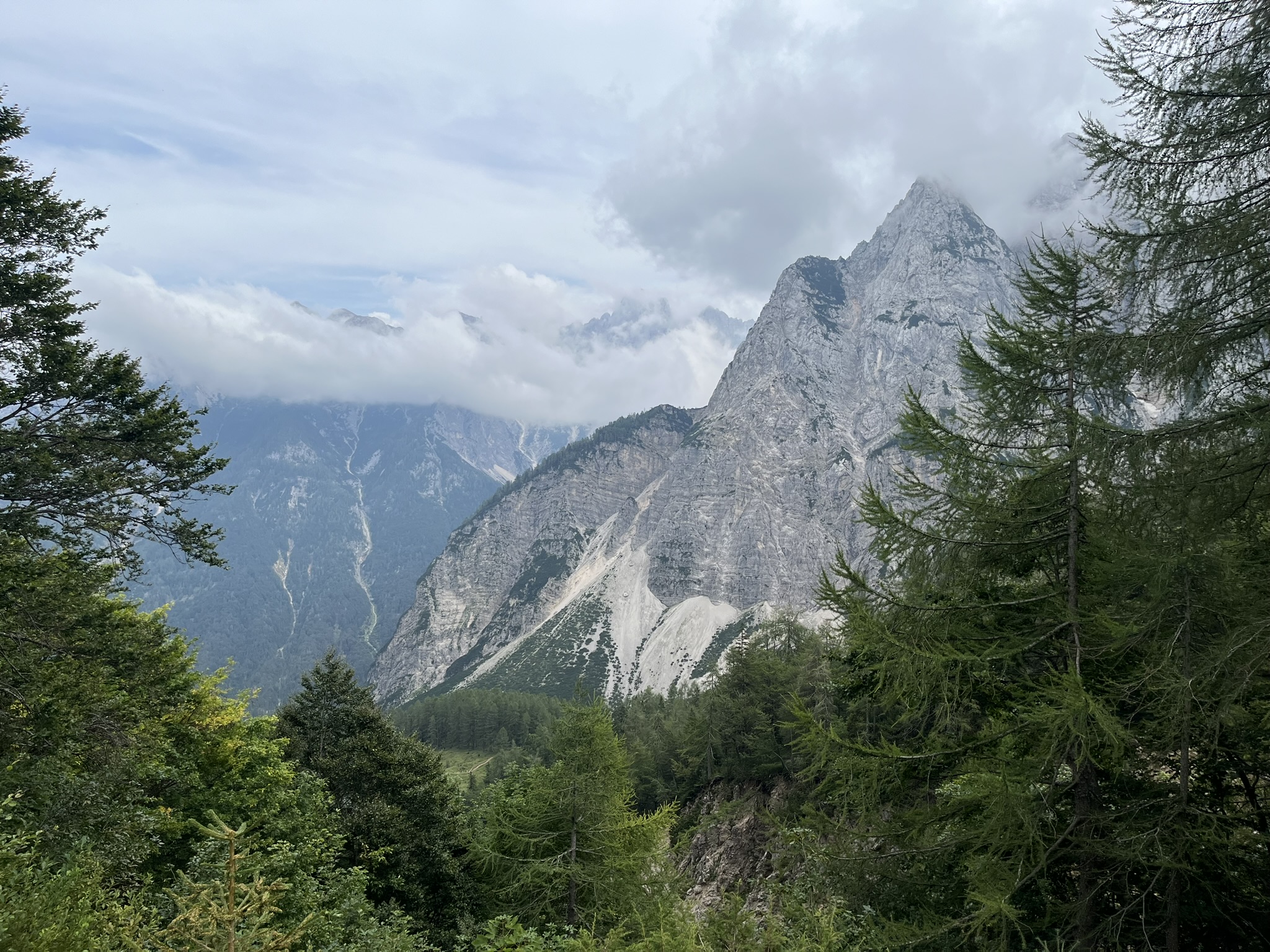
This mountain road connects Kranjska Gora with Trenta and reaches an elevation of 1,611 meters. Travelling this route, you are treated to breathtaking views at every turn, with the dramatic peaks of the Julian Alps looming overhead and valleys unfolding below.
The origins of the Vršič Pass lie deep in the region’s history. During the Ice Ages, powerful glaciers carved and shaped through these mountains, leaving behind sweeping valleys and distinctive rock formations that are still visible today. The road itself began as a rough shepherds’ track, winding through the rugged terrain and used only by locals tending their livestock.
… build on human tragedy.
Everything changed during World War I. The Austria-Hungary empire recognized the strategic importance of a direct route between Kranjska Gora and the Trenta Valley. In response, they ordered the construction of the Vršič Pass road to supply their troops on the Soča front. Building the road at such a high altitude, in a landscape dominated by steep slopes and frequent avalanches, was a major engineering feat. Thousands of workers, including many Russian prisoners of war, battled harsh conditions to complete the project. Today, you can still spot remnants of wartime structures scattered along the route, silent witnesses to the hardships endured here.
More than 10,000 Russian prisoners of war endured forced labour with no more than picks, shovels, and sledges. Hundreds of them worked in harsh conditions and unfortunately died during the construction. Also severe avalanches or premature explosions caused many casualties. A bit before the top, survivors have built a wooden Russian-style Orthodox chapel – in their memory. More specifically, it commemorates the tragic avalanche of March 1916 when far more than 100 POW were killed. In their memory, the road towards the chapel is today called Ruska Cesta.
In 2016, still in better times, Vladimir Putin visited the chapel, a symbol of suffering and reconciliation between nations, on the occasion of its 100th birthday. Ironically, given the current situation, knowing that the chapel is dedicated to Saint Vladimir, a former ruler of Kievan Rus.
Initially, Vršič remained a rough military track. But in the 1950s and 60s, the road was gradually paved with asphalt and reinforced to accommodate modern cars. However, drivers need steady nerves to navigate the approximately 50 hairpin bends along the ascent and descent. The road’s steep grades and narrow passages add to the adventure, and it is mostly closed in winter due to heavy snow and the risk of landslides. As you climb, the views from certain bends are truly breathtaking. Remarkably, the Vršič Pass was recognized as a cultural monument of national importance in 2006, in honor of its historical past.
Stunning views.

Once you reach the top of the Vršič Pass, you are rewarded with one of the finest mountain panoramas in Slovenia. From this vantage point, energetic hikers can set out for Mala Mojstrovka, Jalovec or Slemen’s Špica renowned for their sweeping views of the Julian Alps.
At the viewpoint near “Poštarski dom”, you can catch sight of a curious rock formation in the north wall of Prisank, one of the towering mountains that embrace the pass. This formation is known locally as the “Ajdovska deklica” or ‘Maiden’s Face’. According to legend, she was a gentle giantess who guided travellers safely over the mountains and protected them from avalanches and landslides. She also acted as a fairy godmother, visiting new mothers to foretell the futures of their children. The story goes that one day, she predicted a newborn boy would become a great hunter but would eventually shoot the mythical Zlatorog. This ‘blasphemy’ angered the other giants, who cursed her and turned her into stone—her face now immortalized in the rock for all to see.
Find the right spot.

The stone face is clearly visible from the terrace of the Erjavčeva hut, an ideal spot for hikers to rest and soak in the scenery. As I am not so much into hiking, I convinced myself that the uphill drive was already quite an achievement which deserved a reward. So we enjoyed a hearty Slovenian dish and some dessert at the hut. Built in 1901, rebuilt in stone in 1993 and renovated in 2022, the Erjavčeva hut is notable not just for its welcoming atmosphere but also its owner’s distinctive humor.
The flip side…
Like many popular tourist destinations, Vršič Pass can get quite crowded during peak season. It is not comparable to Austria’s Grossglockner yet, but for a more relaxed experience, plan your visit for late spring or early autumn when the crowds thin out and the scenery is just as stunning.

Parking at the top can be tricky in high season. If you’re willing to tackle a steep but manageable walk, you can usually find a good spot a few hundred meters from the summit. Watch out for the local residents—flocks of sheep often wander freely and may block the road, turning your journey into an unexpected countryside adventure!
Due to recurring traffic jams, reckless parking, noise, and pollution, visitors may soon need to rely on shuttles to reach the top. Of course, if you’re feeling adventurous, you could join the ranks of those who bike or even run all the way from Trenta to Kranjska Gora—the hard way, but certainly unforgettable.
An eccentric event.
But by far the quirkiest cycling event has to be the annual Red Bull Goni Pony race. Held every June since its debut in 2014, this ‘biking classic’ is anything but ordinary. Contestants take on the challenge of riding from Kranjska Gora all the way to the top of the pass—on a Pony. And no, not
the four-legged kind! Instead, this Pony is a legendary Slovenian foldable bike. Renowned for its simple and sturdy design, the Pony features 20-inch wheels, no gears, and is delightfully basic.
The Pony holds a special place in Slovenian culture, having been a fixture on city streets from 1965 to 1985, and now celebrated as a nostalgic icon since production resumed in 2017. Over 350,000 of these bikes were made, making them a cherished symbol for many Slovenians—especially during this eccentric annual event.
The record for the 13.5-kilometre uphill slog stands at an impressive 39 minutes and 39 seconds. But it’s not just about speed. More than 1,300 participants wear vintage and outrageously funny retro outfits, turning the race into a rolling carnival of color and laughter.
I could not find better words to describe it, but if you watch this movie, you will see it for yourself. This event is really totally over the top. 😊
Visit the Vršič Pass
Leave a Reply