

In August 2023, the unleashed floods of the Poljanska Sora river surged with terrifying force, sweeping away the wooden footbridge between Škofja Loka and Puštal, some 25 km northwest of Ljubljana. The raging waters thundered beneath the bridge and for a moment, it truly seemed as if the Devil had returned to reclaim “his” Devil’s bridge. Not even St. John of Nepomuk— guardian of countless bridges throughout Slavic lands—could halt the destruction this time. In the aftermath, only the saint’s shrine stood, remarkably untouched amid swirling debris and muddy currents, while the rest of the bridge, first constructed in 1639, was entirely gone, just as it had been swept away once before in 1926.
The work of the devil.

The name “Devil’s Bridge” draws from a widespread legend found throughout Slovenia and much of Europe, where challenging bridges are said to be the work of the Devil himself. According to the legend, the Devil would demand the soul of the first being to cross the bridge in return for his assistance. However, clever locals often managed to outwit him—by sending an animal across first, much to his frustration. In the picturesque medieval town of Škofja Loka, the story takes such a twist too. But after being tricked, the Devil supposedly unleashed a plague of frogs into the river to disturb the townsfolk’s sleep. This story is quite common across Europe, so folklorists have included it in the Aarne-Thompson folktale index—a system used by scholars to classify and compare folktales from different cultures.
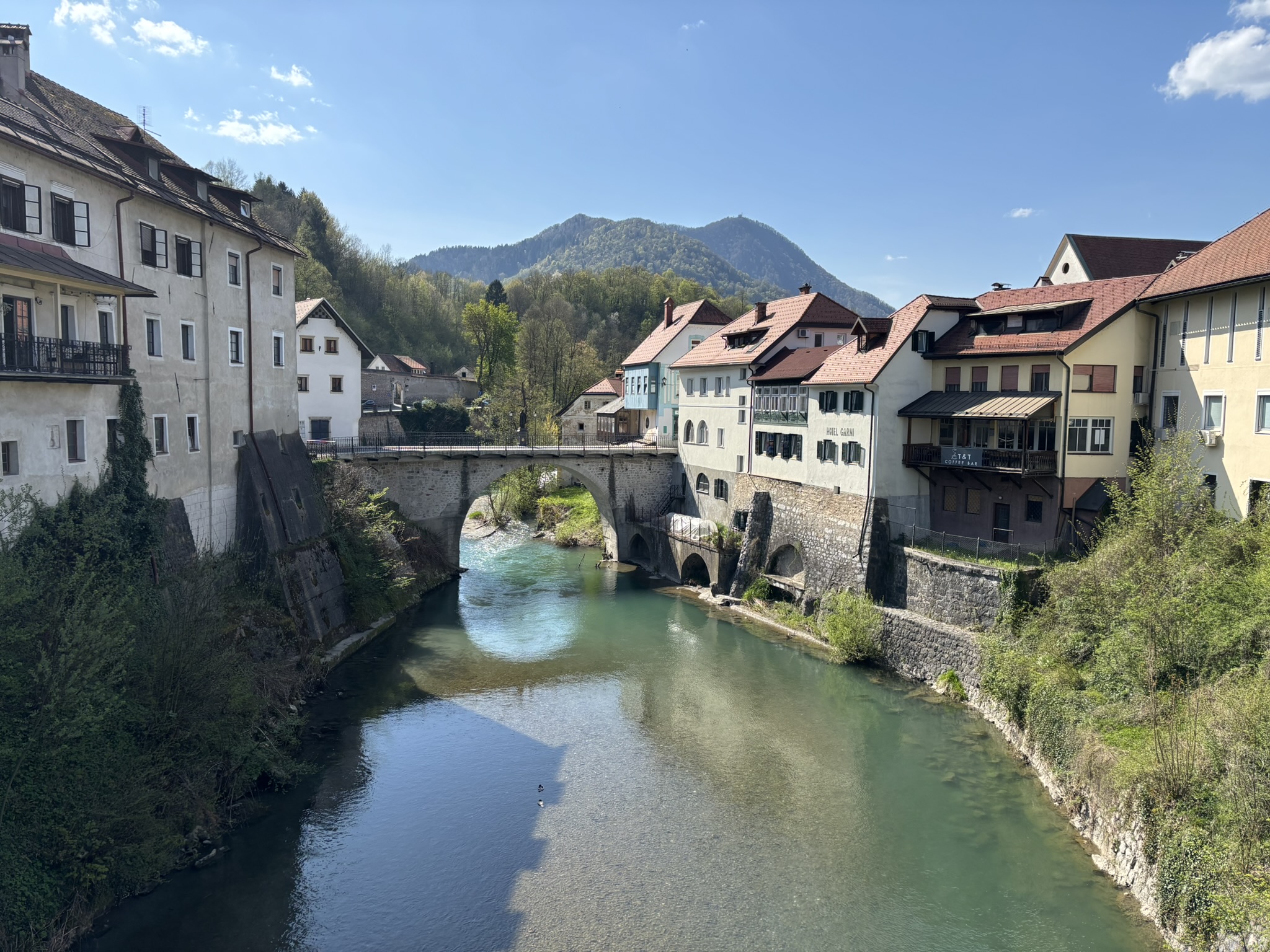
Returning to the present, the catastrophic flood of 2023 inflicted more than 24 million euros in damage upon Škofja Loka, destroying two additional bridges and leaving roads, homes, and public facilities battered in its wake. Yet, amid the devastation, its iconic stone Capuchin Bridge stood unshaken. Built in the 14th century, likely around the same period as Florence’s renowned Ponte Vecchio, this picturesque medieval bridge arches gracefully over the Selška Sora, one of the two rivers that define the city’s landscape. The Capuchin Bridge’s enduring presence is nothing short of extraordinary, having survived the city’s most harrowing moments: the destructive assault by Jan Vitovec in 1457, when flames and chaos swept through Škofja Loka; the relentless Ottoman sieges around 1476; and the infamous earthquake of 1511 that toppled fortresses and homes alike. Even in the tumult of the 20th century, the bridge withstood an attempt to be blown up during World War II.
A city with a story.
The Capuchin bridge is a prominent landmark in Škofja Loka. It illustrates the city’s rich economic and cultural history since Stara Loka, the old Slavic settlement, transformed into a flourishing medieval city. This happened after Emperor Otto II granted it to Abraham the Bishop of Freising in 973. Despite typical medieval setbacks such as the plague, devastating fires, and numerous sieges, Škofja Loka remains the best preserved city of that time in Slovenia. This is most visible at the central square, Mestni Trg, which showcases many colorful façades of late Gothic buildings dating back to the 16th century. Local guilds of craftsmen—including blacksmiths, carpenters, tailors, weavers, hatters, and masons—regularly gathered here.
By then these renowned guilds formed the economic backbone of the city. Among them were also the leather makers. They laid the early foundation for today’s Alpina factory, which continues to be an important local manufacturer of shoes and renowned sportswear.

The significance of Škofja Loka is also visible on Mestni Trg through the Dreifaltigkeitssäule, or Trinity Column, built in 1751. Such monument was traditionally erected in Habsburg cities to commemorate survival from disastrous events. This tradition was reserved for important cities like Prague, Budapest, Vienna or, in Slovenia, Maribor. It highlights Škofja Loka’s prominent status.
As the city’s wealth attracted increasing adversaries, so Bishop Conrad III strengthened its defenses by investing in immense fortifications and city walls between 1314 and 1322. Till 1789 these played a crucial role in protecting the city. Then they were torn down.
Churches, monuments and castles.
For the same reasons, the outskirts of Škofja Loka once featured three impressive castles. Visitors can now explore the “Pot treh gradov“ (three castles road) to discover that only ruins remain of two of them—a result of local uprisings, multiple sieges, the devastating 1511 earthquake, and their eventual dismantling for building materials.
Exploring this path you will first encounter the ruins of the Kobila Castle, dating back to the 11th and 12th centuries. Today, all that remains are the foundations of its donjon atop Krancelj Hill. Also the second castle – the Divja Loka (Wildenlack) – is in rubble. It was built on the hills of Lubnik and it was the power center for the Bishops of Freising, guarding not only the city but also vital trade routes. Today, the Divja Loka leaves behind a desolate and haunting environment.
According to legend, a sorcerer placed a curse on an evil castle daughter, transforming her into a snake doomed to dwell the ruins. Only the kiss of a good-hearted young man can break the spell and set her free. With some local adaptations, also this tale is a quite common folktale which consequently appears in the Aarne-Thompson folktale index .

Anyway, after 1511, military and administrative power shifted to the third fortress, the nearby Škofja Loka Castle. The latter was built in 1202 and also suffered severe damage from the earthquake. However, it was carefully restored in the following years by bishops Philip and John Francis. Their leadership helped Škofja Loka recover and continue to thrive as an economic and cultural hotspot.
You see that Škofja Loka, which means “Bishops Meadow,” owes much of its development to the 47 bishops who ruled the region. The first bishop and “founding father,” Abraham, is said to have spent considerable time in Škofja Loka, learning Slovene and integrating with the local community. This probably also explains why he ordered the creation of the Freising Manuscripts (Brižinski spomeniki). This historic, religious document is valued and considered as the oldest known document written in Slovene.
Abraham’s legacy also endures in a local legend about the coat of arms. It depicts his black servant wearing a red crown—a tribute to the servant’s bravery in saving Abraham from a vicious bear. As the centuries passed, other bishops left their mark on the city, each with a distinct story. Bishop Leopold, the seventeenth bishop, constructed the stone Capuchin bridge that later tragically led to his death when his horse bolted and he fell into the river. Bishop Conrad V is remembered for a more somber event; he was robbed and killed by a servant within Loka Castle. Following him, Bishop Herman, the illegitimate son of Count Herman II of Celje, borrowed so much money that he pawned the entire Loka lordship to his father.
The end of the bishop’s rule.
After 830 years however, the feudal rule of the Freising bishops ended quite tragically. In 1803, the Reichsdeputationshauptschluss led to a major secularization and widespread nationalization of church property within the Habsburg empire. As a result, Škofja Loka became state property and Joseph Conrad, the last clerical ruler, was left without authority or possessions. It is said he died of grief nine years later.
But even under Habsburg state ownership, the region continued to thrive due to its strong economic foundations. Guilds and craftsmen evolved into factory-based industries. For example, the Šešir factory, which produced fashionable hats until 2016, was built on the centuries-old craftsmanship of the hatters.
As economy and urban development often go hand in hand, Škofja Loka continued to flourish and develop. In 1894 it became first city with electric lighting in Slovenia thanks to the developing Industrial Revolution. Alojz Krenner owner of a local cloth factory provided the needed electricity from his own early power station.
A city with a rich cultural heritage.
And also intellectual and cultural development thrived on the back of the economy. In the late 1890s, Slovene impressionism emerged in Škofja Loka with the arrival of Ivan Grohar, who created many of his most important works here. One such piece, “Škofja Loka v snegu” (Škofja Loka in the Snow), was painted in 1905 at the Homan House, one of the beautifully preserved buildings on Mestni Trg. At that time, the Homan House operated as an inn that Grohar often frequented.
At the beginning of the 20th century, the economy declined. As a result, many people emigrated to European countries with labor shortages in search of work. Maasmechelen, a town in Belgium, at that time known for its coal mining industry, became a hub for Slovene immigrants seeking employment. Several waves of emigration continued until the 1960s. This strong historical connection is likely the main reason why Škofja Loka is twinned with Maasmechelen, a city with a close-knit Slovenian community.
Besides the bishops, also religious orders have heavily shaped living conditions and culture in the region. One significant example is the Škofja Loka Passion Play, written between 1715 and 1721 by the Capuchin friar Romuald, who recorded an ancient religious tradition. This play, the oldest passion play in Slovene, dramatizes Biblical stories in 869 verses across 13 “tableaux vivants.” The procession involves more than 600 participants and is still performed every six years during Lent. The Škofja Loka Passion Play is a cornerstone of Slovene cultural heritage, notable for its longevity, community involvement, and role in preserving Slovene language and traditions. In 2016, the passion play was recognized as UNESCO Intangible Cultural Heritage, highlighting its enduring cultural significance.
Also Ursuline nuns played a vital role in educating schoolgirls and supporting the poor and sick. They also contributed significantly to the preservation of Loka Castle, which they acquired in 1890. They renovated the castle’s medieval exterior, giving it a more contemporary appearance. The updated building was then integrated into their nearby cloister.
Despite waves of Protestantism and nearly fifty years under communist rule, Škofja Loka remains filled with churches showcasing beautiful statues, artwork, frescoes, and shrines. The architecture of the central Parish Church of St. Jacob is an unusual blend of medieval foundations over Renaissance and Baroque to the 20th‑century Slovene modernist design of Jože Plečnik. But the most remarkable church, is located just outside the city. In Crngrob, the Church of the Annunciation of Mary became a notable pilgrimage site after its construction in the 13th century. The church is unusually large for such a small community, but the continuous flow of donations from pilgrims allowed it to keep expanding. Inside, visitors can see many well-preserved medieval frescoes and no fewer than eight altars. Above the altar of Saint Martin, a huge rib is displayed. According to legend, this is the rib of a Pagan Girl who helped build the church but then died from exhaustion.
Believe it or not, but also this story is not exclusive to Škofja Loka. As is the case for the Devil Bridge, such narrative is used to explain the existence of massive buildings. For example, in Trondheim, Norway, legend claims the Nidaros Cathedral was built by a giant named Skalle. Not far away from Škofja Loka, in San Candido, South Tyrol, the local church also displays a giant bone with a similar tale about a “helpful giant” called Baranci.
Full of legends, but as real as can be.
These legends, like the ones from Škofja Loka, blend myth and history, reflecting how communities understood and explained their world. Once a narrative was born, minstrels and bards served as the “social media of their time”, carrying stories and (fake) news as they traveled, tweaking it to make it more spectacular. Their tales moved with migrating tribes, shaping culture and identity across regions.
But, no doubt, Škofja Loka is as real as can be. Although you won’t find it in the Aarne-Thompson index, the city certainly deserves a place under “F760 (Extraordinary cities)”. But since we do have social media today, you can easily verify its fairytale alloy yourself here, here and here.
Or even better, go there yourself.
Visit: Škofja Loka – Google Maps
Visit Crngrob and surroundings: Crngrob – Google Maps
Leave a Reply