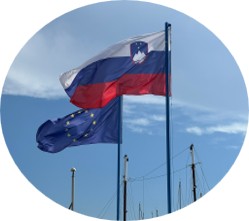
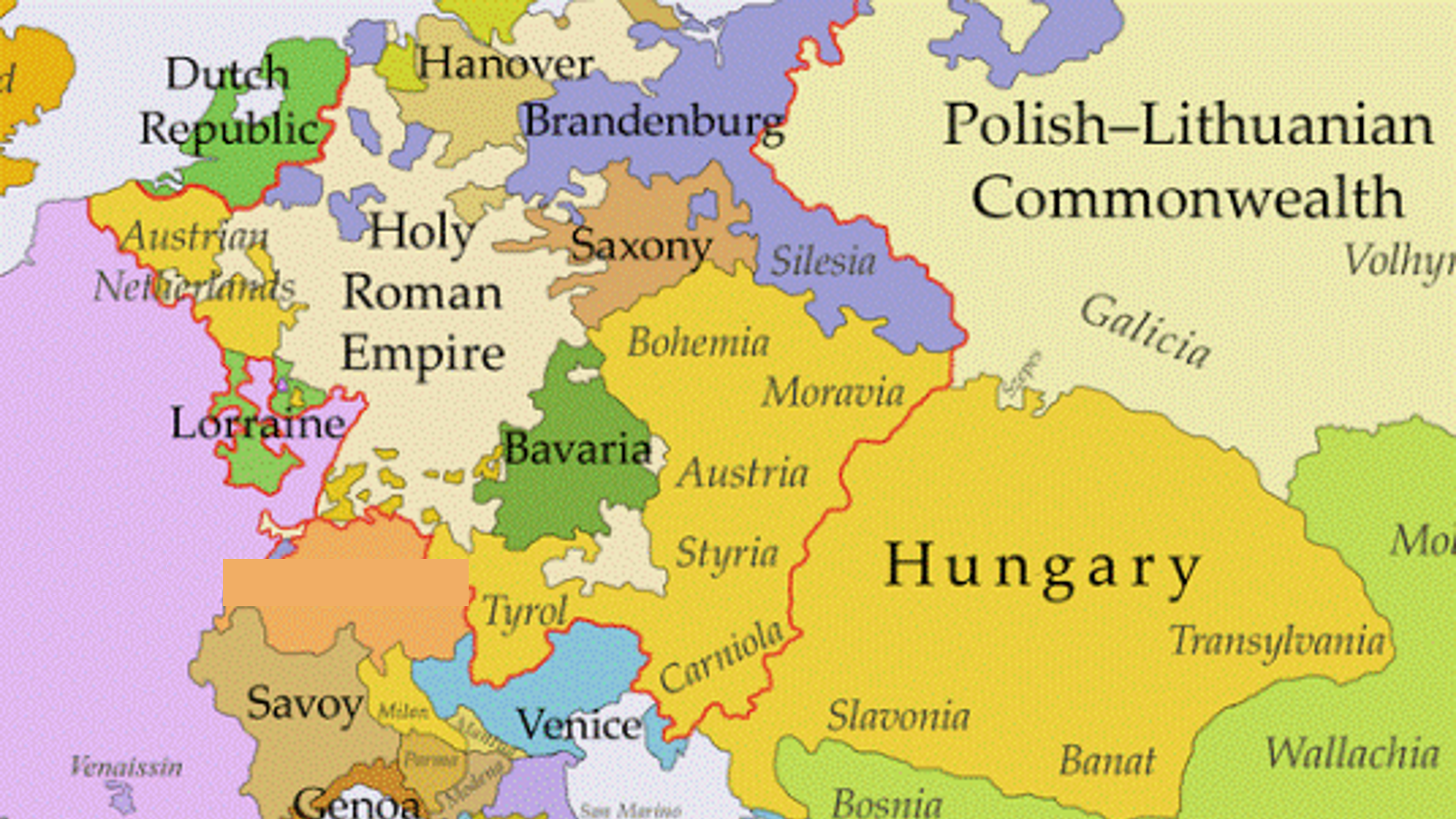

The distance between Brussels and Ljubljana is roughly 1200 km. And yet these cities were once part of the same country. No, we are not referring to the Roman empire, which vast territory once contained large parts of Europe and Africa. But after its collapse, a kind of medieval “European Union” emerged. The so called Holy Roman Empire was a “polity”, an alliance of different countries which cooperated on political and military level. Charlemagne was its first overarching ruler. In 800 Pope Leo III crowned him “Emperor of the Romans,” uniting spiritual and secular power. Later, in 1254, this unity was named the “Holy Roman Empire”, even more stressing the influence of Christianity. For hundreds of years to follow, the balance of powers in the covenant was frequently changing. But around 1714 the Habsburg monarchy became the dominant and stable powerhouse with, for most of the time, Maria-Theresia as empress.

Indeed, her name is familiar in both regions, as substantial parts of Flanders and Slovenia were under Habsburg-Austrian rule at that time. If you look carefully in the emperor’s seal, you will see the coat of arms of both Flanders and the Duchy of Carniola.

From a difficult start …
Maria-Theresia’s reign was already remarkable because, by then, female heirs were excluded from the throne. Her father, Charles VI, had to issue the “Pragmatic Sanction”, an exception to Salic laws, to get her on the throne. Therefore, her position was heavily challenged which led to the “Austrian succession wars”. But she managed to survive and strengthen her impact. She believed that stability and prosperity would generate sufficient tax revenue to sustain lasting peace, good government and military strength. Her government had a substantial impact on agriculture, the economy and social relationships.
to groundbreaking reforms.
A progressive and daring economic reform was the introduction of the first paper money, the Bancozettel in 1762. With many other bureaucratic measures, she transformed and developed society so it could finally step away from the dark Middle-Ages. To illustrate this; Maria Theresia forbade the horrible practice of witch burnings in her entire empire.
Therefore, she is recognized as one of the most important European sovereigns ever.
Her “General School Ordinance” required children aged 6 – 12 to attend school, using Slovene textbooks – a groundbreaking policy for that time. It increased literacy and restored pride and confidence among the Slovene-speaking population. For the first time Slovene as a language was recognized and used in government communication.

Her agricultural reforms were inspired by “physiocracy”, the belief that farmers are the foundation of society. These measures became a real turn around. Farmers got more rights and were protected against excessive demands of landlords. She promoted agricultural cooperations which invested in education, diversification of crops, irrigation and more. She also issued decrees to make populations more resilient and self-sustainable, sometimes even with very detailed decrees. An example is the order that every household should at least plant one Tepka tree. Its pears could namely be dried and used as flour for bread in the winter season. The name “Tepka” comes from the word “tepen”, meaning “to beat” – a reference to the supposed punishment for not planting the tree. This, however, was hardly necessary as the people of Zasip near Bled soon discovered that the pears could be used to make a good pear liquor. This tradition still stands today.
Potatoes were also planted mandatorily, but it took years before farmers considered them suitable for human instead of cattle feed. Still, the event was significant enough to merit its own monument in Šenčur. It honors – who else – Maria-Theresa for introducing this indispensable ingredient to the Slovene cuisine.
Maria-Theresia’s impact is today also still evident in the Slovenian beekeeping tradition. In 1770 she appointed Slovene Anton Janša as her royal beekeeper. He made the status of the Carnolan bee official, which is nowadays still the only native bee in Slovenia. The traditional, artistically decorated, cubical beehives still seen today, are credited to him (and to her support).
Slovenia’s other pride, the Lipizzaner horses, obtained its status under Maria-Theresia who was a passionate supporter of the grey-to-white breed. Her influence made them the favorite horses of the Habsburg court and the exclusive breed of the Spanish Riding School in Vienna.
Not Bordeaux but Brda…

Another remarkable merit is the world’s first CRU classification she introduced in 1787 for vineyards in the region of Goriška Brda, Vipava and parts of Italy such as Aquileia. The so-called “Gorizia and Gardisca Classification“ describes wine by quality and prescribes criteria for its production. This is years before the famous French Bordeaux classification (1855) which is considered the world’s oldest. The document was rediscovered in the archives of the Counts Formentini and Attems by Stefano Cosma, a prominent Italian wine connoisseur. Today some eminent winemakers again subscribe the principles and produce wine according to this classification.
Every year, part of their production is donated to the Association of the Knights of the Cru Classification of Empress Maria Theresa. The wine is put up for auction to the benefit of the historic Monastery of Kostanjevica in Nova Gorica. The association also promotes cooperation and good relationship between the two regions involved.
Recognized as one of the greatest European rulers.
You see the empress left a remarkable footprint in Europe’s and Slovenia’s history. It is no wonder that several countries of the old empire issued a joined stamp in 2017 to commemorate her 300th birthday. Svetlana Milijaševič, a Slovenian artist, was the designer of the stamp which was evidently also issued by Slovenia. It honored the legacy of this strong woman, for whom few would have wagered a dime (or better a Thaler) on her surviving the first year on the throne.
Recently, a musical about her life is performed in Vienna’s Ronacher theatre. One of the songs – “Wo ist die Krajina” – refers to current-day Slovenia.
Back to the beginning of the story… Maria-Theresia’s reign brought stability and improved living conditions for our ancestors. But her reforms also met resistance. Local authorities rebelled the erosion of the feudal system she wanted to get rid of.
Our roads separate again…
Opposition to excessive bureaucracy and the erosion of the local power grew. Local nobility supported by the church started a fierce uprising against her son Franz II. The Austrians temporarily lost control over Flanders but his brother, Leopold II, managed to regain power after a few years. Still the position of the Austrians was severely weakened. In 1794, the French invaded Flanders, pushed out the Austrians for good and we were no longer “compatriots.” However… what about Napoleon and his conquest of the Illyrian Provinces ? Time for yet another story.
Leave a Reply