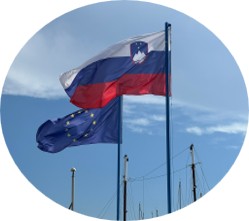


Ask any Slovene what Triglav stands for and they will all proudly tell you about their “three headed mountain”, the highest of Slovenia. To prove the point… Slovenia’s artwork representation of Triglav, by Milenko Matanovic, in 1968, started more or less as a joke, but it is now even called the most significant post-modern artwork in Slovenia.
The common roots of Slavic religion.
But much less people will refer to Triglav, the pagan God which the Slavs brought with them when they migrated around the 7th century from Moravia to “the sunny side of the Alps”. Just like the famous mountain, Triglav had three heads, all looking in a different direction, said to be earth (present), sky (future) and underworld (past).

Deities with more heads were not a rarity in these times. Think for instance about the Roman god Janus (two faces) or the Slavic gods Svetovit (four heads), Porevit (five heads) and even gods with 7 heads existed.
Whether or not Triglav gave its name to the mountain, is subject to debate, but it is a fact that the cultus of Triglav was very prominent in Carantania, the region of the notorious mountain. The oldest referrals are found in Lagole di Calalzo which is today northern Italy, close to the Slovenian border. The Triglav cult is not unique for Slovenia. Also, in Bosnia, Czech Republic and Poland (Szczecin) he was worshipped, a clear example of the common roots of European Slavs.

The great erasure.
Tangible remainders of pagan gods are very rare, because Christianity persistently erased every trace of the old faith around the 12th century. Statues were destroyed, temples were converted into churches and old gods were massively recuperated and transformed into Christian saints. For instance, Perun (God of thunder) was transformed into prophet Elijah and in Bled, the temple of Živa was, likewise, converted into a church for Maria, the mother of God. But despite this, even today the ancient Gods still live on in many aspects of Slavic culture and language. Gods like Rod (roditi), Živa (živeti), Zemlja (earth) still live on in language and celebrations. And “raj”, the paradise garden full of magical flowers below Triglav (rajski vrt) translates as “delight”.
One of the rare remainders of the old cult can be found in the surroundings of Gradišče. The so called Krkavški Kamen, is a 2.5m high stone which is also known as the Triglav stone. In fact he is dedicated to Svetovid, the sun god. According to the tradition, locals celebrate here the beginning of the summer and winter and on St Vid (the good old Svetovid) people gathered to lay their hands on the stone. Today, only a replica still stands there, the original can be admired in the Regional Museum of Koper.

Hardly, but carefully preserved.
These are only a few examples of how many Slovenian traditions are in fact remainders of the indigenous pre-Christian religion of the initial Slavic population in Central Europe.
Some Slovenes still investigate these old myths and want to preserve the little we still know about them. The“Slovenski staroverci”, (Slovene old believers) as they call themselves, are keeping record and promoting the old Slovenian faith.
It is said that Bishop Otto von Bamsberg was the most active in pushing the old believe into oblivion. And he succeeded quite well in his effort to erase the likes of Dazbog, Belobog, Svarog or Mokosh. But in Triglav, it seems that he found his master. His 2.864-meter highness cannot just be pushed aside. Eat this Otto 😊.
Leave a Reply