

Hell on earth … There is no better way to describe what is now Slovenia, some 50 million years ago. At that time, during the Alpine orogeny, tectonic shifts slowly pushed the Adriatic microplate against the Eurasian continent. The immense pressure folded sediment deposits from the Tethys Ocean – an ancient ocean that once separated continents – resulting in a tiny, yearly, but steady, elevation. Slowly the Alps rose to their present-day size. Intense earthquakes, avalanches of debris, deep surface cracks with outbursts of lava, and huge steam fountains were daily occurrences. When this inferno calmed down, some 2.6 million years ago, the dust literally settled during the Pleistocene. Then, glaciers carved deep valleys with a constant stream of rubble, melting ice, and rushing water. They shaped vast lakes like Lake Bohinj and deep canyons such as the Vintgar and Tolmin Gorge.
Exit hell, enter paradise.
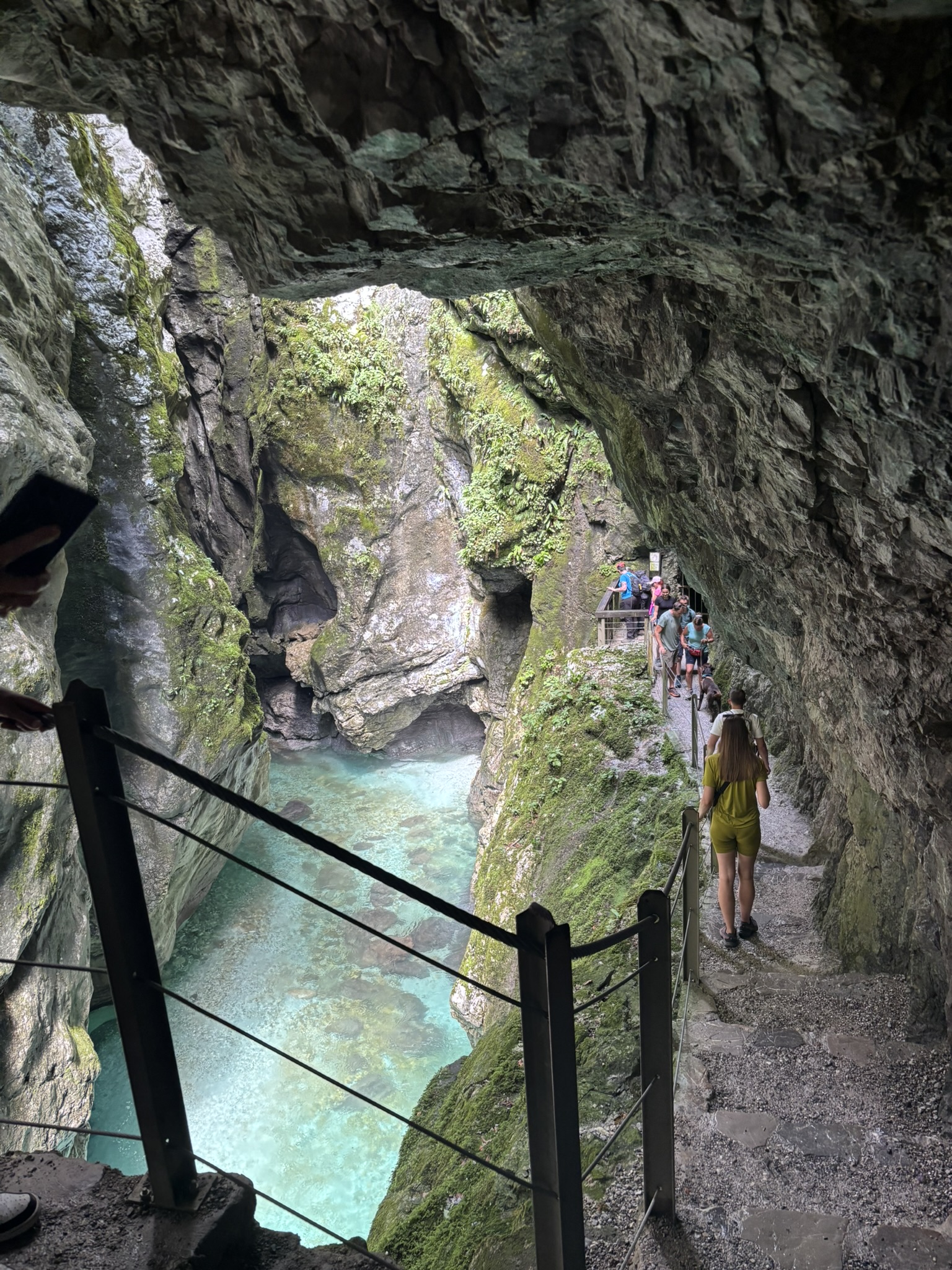
Today, the Tolmin Gorge is an overwhelming green landscape, filled with steep slopes, massive rocks, waterfalls, and rapids—all silent witnesses of its violent geologic past.
The path takes you through a magnificent environment where two rivers—the Tolminka and Zadlaščica—wind through the landscape before merging in a 60-meter-deep creek.
As you continue along the trail, you can walk for about 2.5 km over wooden bridges and stairs, enjoying the pristine nature and several natural attractions. Further along your walk, you’ll encounter the Osojnica waterfall and the “Bear’s head,” a massive boulder trapped between the narrow slopes of the ravine.
At the end, a hot water spring—a final reminder of the intense volcanic activity—rushes out of a cave and splashes into the cold, turbulent river. This creates a mystical fog that slowly floats over the water, and when the sun’s rays peek through, it forms an unreal, almost enchanting scene.
Devine inspiration.
In such a setting, it is easy to imagine that Dante Alighieri found inspiration here for his Divine Comedy, a masterpiece of Italian literature. The famous Florentine philosopher and writer lived between 1265 and 1321, and in 1319 he was allegedly invited by the patriarch of Aquileia to visit Kozlov Rob, a nearby castle. Although Dante’s visit to Kozlov Rob is not confirmed by contemporary records, 16th-century sources later claimed he stayed in the area. More specifically, it was the nearby Zadlaška Cave—since then called Dante’s cave—that is said to have inspired his depiction of Hell, the first and darkest part of his epic poem. Local legends suggest that the cave’s dark chambers and eerie atmosphere (video) influenced Dante’s vivid descriptions of the infernal landscape in his Divine Comedy. The cavern itself, with its several chambers spanning a total of 1,140 meters in length and reaching 41 meters deep, certainly provides a spooky and evocative environment for such inspiration.

The Divine Comedy, comprising a total of 14,233 lines, is grounded in medieval Catholic theology. In this masterwork, Dante chronicles the journey of his soul through the afterlife, traversing Hell (Inferno) and Purgatory guided by the Roman poet Virgil. The verses reflect his many emotional scars and traumas, stemming in part from his harrowing experiences as a soldier in the Battle of Campaldino (1289). Drawing from his traumatic experiences in battle, Dante crafts scenes of suffering that mirror his own emotional turmoil. This connection between personal history and literary creation is evident as he guides readers from the depths of Inferno to the hope found in Paradiso. His famous declaration, “Abandon all hope, you who enter here,” powerfully conveys his internal torment as well as the atmospheric dread of the cave’s setting. The raw, narrow passages, dripping stone, broken paths, dangerously tilting rocks, rising temperatures, and profound darkness all evoke a descent into the underworld. This striking similarity between the cavern’s oppressive ambiance and the bleak imagery of Inferno supports the local tradition that Dante found inspiration here.
Ultimately, Dante makes it to Heaven (Paradiso) where his idealized muse Beatrice awaits him. She was a Florentine who was nine years old when they met and he instantly fell in love. However she married a wealthy banker and died at young age. He tried to ease the lasting pain by recreating her as a divine figure. A figurative happy ending after all…
Dante wove many real people from his life into the narrative. Particularly those who wronged him, were depicted as devils or condemned souls in hell. Dante, who had numerous adversaries, did not shy away from assigning them places of suffering in his vision of the afterlife.
Friend of foe ?

One of them was Pope Boniface VIII who was the reason that Dante was facing death penalty and expelled from Florence. Dante wrongly choose side of “the White Guelphs”, who opposed the papal power in Florentine affairs. For his enemies, such as the pope, he reserved places in one of the nine circles of Hell to which sinners are assigned for adequate punishment according to their sins.
Dante also included the tragic lovers Paolo and Francesca, who were murdered by Francesca’s jealous husband. Their story appears in the second circle of hell, reserved for those guilty of lust. This tale of forbidden love inspired Auguste Rodin’s masterpiece sculpture “The Kiss,” as well as “The Thinker,” which represents Dante himself. Both bronze statues were originally conceived as part of Rodin’s larger project, “The Gates of Hell.” Additionally, composers like Liszt, Tchaikovsky, and Tangerine Dream have created symphonies inspired by Dante’s work.
Dante completed this iconic work of Western literature in 1321 in Ravenna, where he died soon after from malaria. However, according to local tradition, a substantial part of his Commedia is said to have been written during his exile at the Slovenian coast, more specifically in Izola.

A controversial presence.
In 1929, the Italian authorities installed a bust of Dante in the center of Tolmin, effectively acknowledging the widespread legend. Following World War II, the statue was relocated to the entrance of the cave. However, due to its strong association with atrocities committed by the fascist regime, it was ultimately moved to the local museum, where it remains on display today.
Could it be real ?
In 2021, Dante’s place at the cave was taken by the wooden statue of Duga Baba, a mythological “wild woman” rooted in the ancient Slavic legend of Baba Yaga. Baba Yaga, known across Slavic folklore as a mysterious witch who dwells in the forest, often serves as both a helper and a hindrance to travelers. Duga Baba, her local counterpart, embodies these same enigmatic qualities. In local traditions, she was part protector of travelers, but sometimes also a prankster who ordered passersby to carry her across the wild river. Most importantly, she was considered the gatekeeper to the cave, which is said to be very difficult to explore—a challenge that makes booking an experienced guide in advance essential.

Today—some 50 million years later—“Hell on earth” has been swallowed by the underground but still looms deep down in the cave, while paradise flourishes on the surface. So, Duga Baba didn’t even need to convince me to stay out of the cave. I chose for the walk through paradise, which the overwhelming Tolmin Gorge is today. Yet, I couldn’t shake the feeling that, all the time, Duga Baba was sitting on my shoulders, whispering in my ear: “carry me through the river.”
Friend of foe ?
However, later on she rewarded me for it. Nothing special—just a cold beer after a demanding walk and a smile from the beautiful waitress at Tolminska Korita, the local tavern. For that moment, she became my “Beatrice”, my personal guide through paradise, and I thought: “why not write a blog about her?” But don’t expect a masterpiece here. After all, I am not Dante. 😊
Go see…
Visit Tolmin Gorge: tolmin gorge – Google Maps
Visit Tomin Museum: Tolminski muzej – Google Maps
Visit Sotočje Tolminke in Soče: Sotočje Tolminke in Soče – Google Maps
Visit Koslov Rob: Kozlov rob – Google Maps
Leave a Reply