

In 1968, Arthur C. Clarke wrote “2001: A Space Odyssey,” a book that achieved even greater fame with Stanley Kubrick’s film adaptation, particularly for its striking depiction of a “space wheel” orbiting Earth. While audiences marveled at Kubrick’s cinematic vision, few realized that many of these futuristic concepts had been anticipated decades earlier by a Slovenian engineer. Herman Potočnik, also known by his pseudonym
Hermann Noordung, was a pioneering thinker whose work laid the groundwork for modern astronautics. In his 1929 book, Potočnik provided detailed descriptions and technical drawings of a rotating space station designed to simulate gravity through centrifugal force. These innovative ideas directly inspired later depictions of space habitats, including the iconic “space wheel” featured in “2001: A Space Odyssey.”
Potočnik was born in Pula and served as an engineer for bridges and railways in the Austrian army, but his military career was cut short due to tuberculosis. Impoverished, he chose to resume his studies, enrolling at a technical high school in Vienna with a focus on rocket engineering. He graduated in 1922, relying on the financial support of his brother Albert to complete his education. Potočnik’s visionary concepts not only influenced Clarke and Kubrik’s groundbreaking work but also shaped the broader trajectory of space exploration for generations to come.
Shaping a generation of space engineers.

In 1928, Herman Potočnik published a groundbreaking book using the pseudonym Hermann Noordung. He likely chose this name to earn greater respect from the mostly German members of the forward-thinking “Society for Space Travel.” The book, titled “Das Problem der Befahrung des Weltraums: der Raketen-Motor,” presented his vision for future space flights. Potočnik was among the first to imagine not just leaving Earth, but also returning safely. He even envisioned journeys to other planets beginning from Earth’s orbit.
To help readers visualize these bold ideas, Potočnik included hundreds of detailed illustrations, making his concepts vivid and accessible. He calculated important data and explored the practical consequences of using geostationary satellites at an altitude of 35,900 kilometers. This concept was influenced by the Russian scientist Konstantin Tsiolkovsky, who is often called the “father of astronautics” for his pioneering work in rocketry and spaceflight theory.
Potočnik also focused on the idea of rocket propulsion, a key element for reaching space. Decades later, Wernher von Braun, who led NASA’s Apollo program, called Potočnik’s work “a turning point” in modern space technology. The influence didn’t stop there. Sergey Korolev, the chief designer behind the Soviet Union’s first hybrid-fueled rockets and the mastermind of early space missions, was also an avid reader of Potočnik’s work.
The habitat wheel.

But perhaps his most remarkable contribution was the visionary idea of launching an artificial “Earth satellite”—a complex space station that featured a habitat wheel, a power station, and an observatory, all connected by tethers. The “habitat wheel” refers to a large, rotating structure, 30 meters in diameter and rotating every 8 seconds. It was designed to create artificial gravity. As it spins, centrifugal force pushes occupants outward, simulating the effect of gravity and making long-term habitation in space, in Earth-like conditions, possible. Even before such technology existed, Potočnik proposed harnessing solar energy. He imagined “helium converters”—parabolic mirror devices – which could capture the Sun’s power by converting helium into usable energy, perhaps via steam engines. He also outlined principles for recycling air and water, anticipating sustainable life support systems that are now standard in modern space missions.
Building on these innovative concepts, he considered how astronauts would actually interact with, and access the station. For instance, he suggested the use of a “space gate,” an entry and docking system enabling spacecraft or personnel to safely connect with the station. Communication between the station and Earth, he wrote, would rely on radio waves—a technology only recently proven by Marconi in 1901—showing his ability to foresee practical methods for maintaining contact over vast distances.
To help others visualize his ideas, Potočnik created hundreds of detailed illustrations, including a depiction of the giant spinning wheel. The resemblance of his “space wheel” to Kubrik’s Space Station V in “2001: A Space Odyssey” is striking, highlighting how Potočnik’s early concepts also influenced the portrayal of space habitats in popular film culture.

Recognition at last…
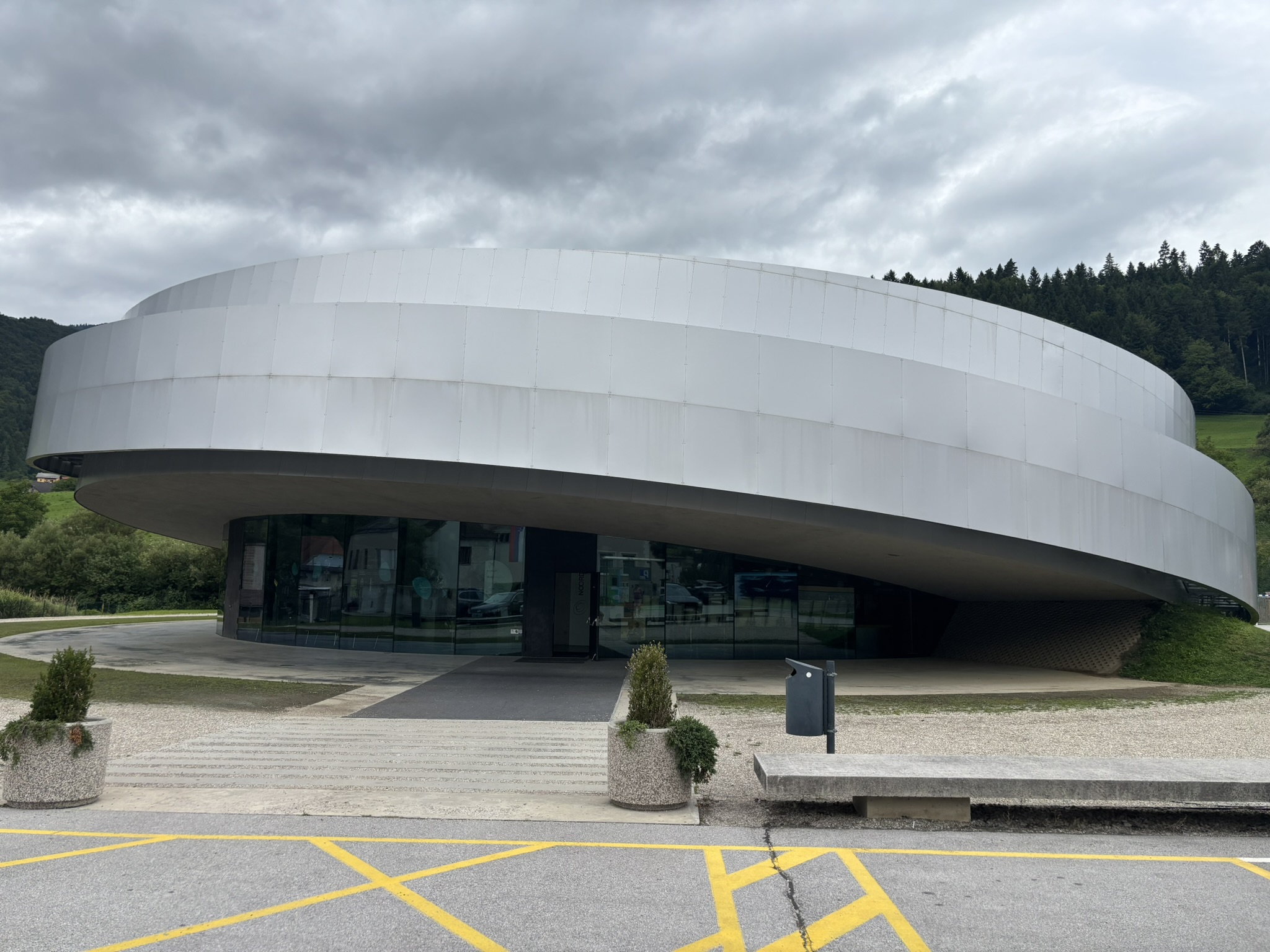
To honor his important work and promote Slovenia’s contribution to space exploration, a space technology center was built in the small town of Vitanje, where his family had its roots. The building features a futuristic shape and closely resembles the famous Space Station V. The main activity of the institute, called the Noordung Centre, is to promote his legacy, and ensure greater international recognition of Slovenian space institutions and companies.
Potočnik’s however never enjoyed his revolutionary status as a space-icon because his life was tragically short. Herman Potočnik died in Vienna only two months after his book was published. In 1929, at the age of 36, the tuberculosis he contracted during military service proved fatal. And history almost forgot him. Even his grave remained unknown for a long time until it was rediscovered in 2012.
But soon after his death, Herman Potočnik’s book began an extraordinary “trip around the world.” It was translated into English, later into Russian, and a summary appeared in the American magazine Science Wonder Stories. In the years following World War II, as his “fan club” came to include renowned rocket scientists like Wernher von Braun, people recognized just how remarkably Potočnik’s early ideas anticipated the realities of modern space technology.
A legacy of space factories.
Building on Potočnik’s legacy, Slovenian institutions continue to push the boundaries of space research today. For instance, his hometown of Maribor is now home to SkyLabs, recognized for developing compact, high-tech modules with low weight and power consumption, which are essential for modern nanosatellites. In 2024, SkyLabs contributed key technology to the TRISAT-R mission, a Slovenian nanosatellite launched into low Earth orbit to monitor space weather and demonstrate the robustness of their systems during high-radiation events.

In Planica, research centers are actively studying another of Potočnik’s pioneering ideas. They study the effects of non-gravity on astronauts’ health during space travel.
Fun fact: even Slovenian culinary teams are making their mark on space exploration. In 2024, a team from Slovenia became the only international group to reach the final round of NASA’s HUNCH Culinary Challenge, a global competition seeking innovative “space recipes” suitable for the International Space Station. If astronaut with Slovenian roots, Sunita Williams enjoyed a warm, flavorful meal during her extended stay at the ISS, there’s a good chance the Slovenian team’s culinary creativity played a part in it.
Inspiring a new generation ?
Thanks to the local expertise of Slovenian scientists, Slovenia is now able to fully contribute to space development as it recently became a full member of the European Space Agency (ESA). This achievement was celebrated—where else—at the Noordung Centre in Vitanje on January 10, 2025.
Who knows—perhaps today’s exhibition will inspire a new generation of visionaries, and in another hundred years, we’ll celebrate their groundbreaking contributions just as we do today.
Leave a Reply