
Echoes of ancient spirits, a Greek bishop, Coca-Cola and Tito … have woven together to create a unique December, packed with traditions, leaving Slovenian children with a festive season unlike any other. To understand this, we have to go way back in time.
For our early ancestors, December was the month they celebrated the solstice—a crucial turning point that marked the gradual return of sunlight and hope during the long, dark winter. Finally the harshness of the season would begin to wane. Villagers gathered together as food supplies dwindled and life grew tough. People believed that, at, this point, the evil spirits roaming the long nights were losing their power, so they donned masks, lit torches, and paraded through the streets, rattling chains to chase away winter demons. This custom was widespread in Pagan Europe. Similarly, in northern Europe Odin led the “Wild Hunt” seated on his eight-legged horse named Sleipnir. Children would leave some carrots and in return they found some small gifts in the morning. Meanwhile, in southern regions, creatures called Krampus (Parklji in Slovene) appeared as goat-like demons to punish misbehaving children. It is not difficult to recognize these rites in modern traditions starting with Miklavževanje, the Slovenian Saint Nicholas.
The Catholic alternative.
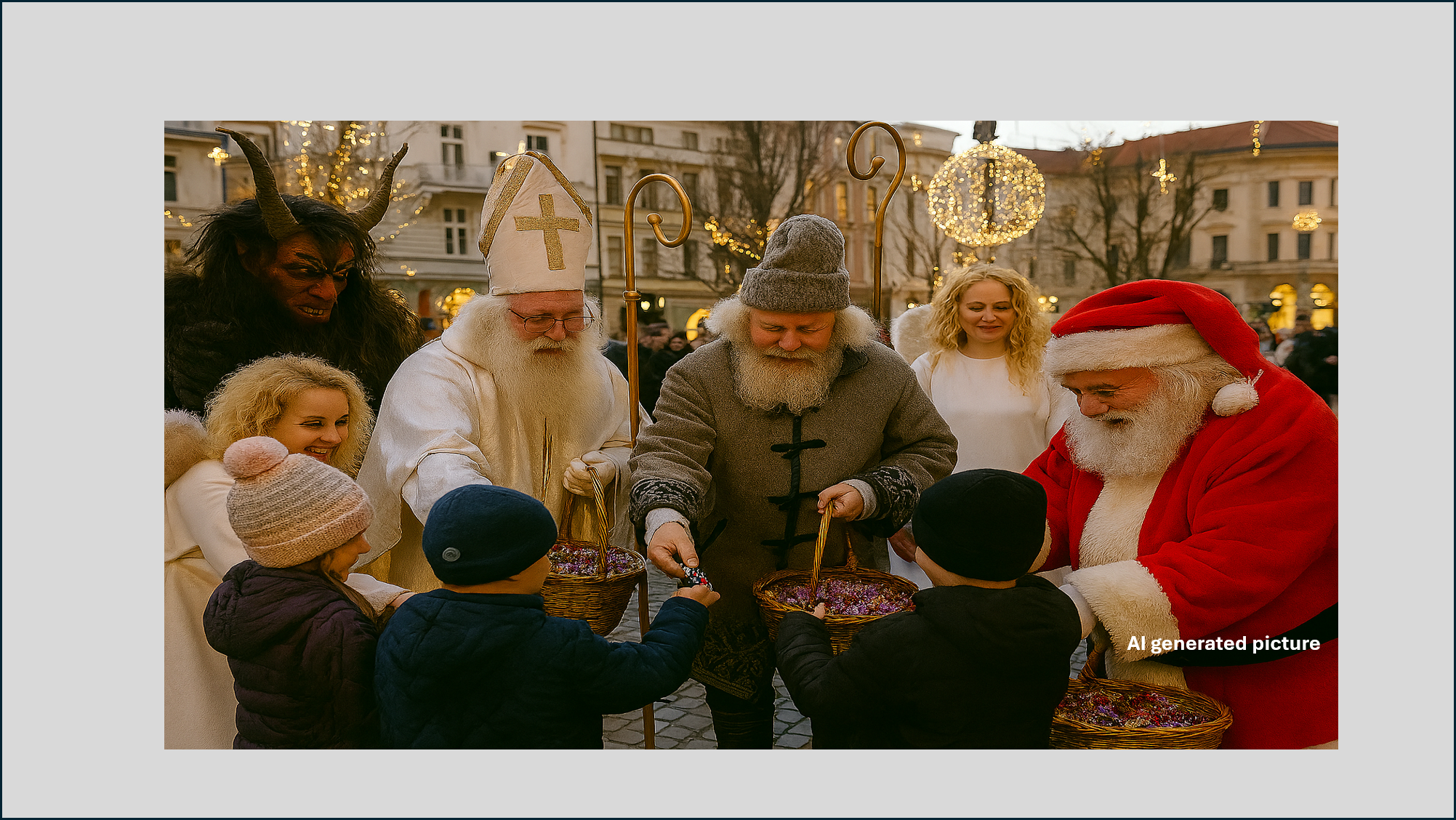
Indeed, on the 5th of December Miklavž appears in many processions. He has a long white beard, a bishop’s robe, miter, white gloves and a staff, symbolizing pastoral authority. He looks like a token of Christian iconography, but , the figure of Miklavž is actually a “pagan makeover” intended to facilitate religious conversion.

Living in Myra (modern-day Demre in Turkey), Saint Nicholas was elected bishop in the 4th century, persecuted by the Romans and imprisoned for his faith in 310 AD.
He was known for his generosity to the poor, especially children. Legend has it that St Nicholas, at night, pushed some lumps of gold through the window of three impoverished girls. The gold served as a decent dowry and saved them from a shameful fate. According to another story, he saved three young children, who had been killed by a butcher to be sold as meat. Shortly after his death on 6th of December 324, people began to venerate him on this particular day. In 1086, Italian sailors transferred his remains to Bari, where he still rests today. Since then, he is also the patron of sailors, and the event earned him an extra day of celebration – the 9th of May – in Tsarist Russia. Today, Slovenia has the largest number of churches dedicated to St. Nicholas – more than 200 – with the Ljubljana Cathedral being the most prominent.
But more important, his legend makes that still today, all over Europe, children put their shoes, with a gleam in their eyes, hoping for some presents. In the early days he brought candy, walnuts, dried fruit and later, when living conditions approved, also chocolate, oranges and toys. Always Miklavž is accompanied by a motley crew of white angels and the “converted” parkelji, who in some places whip naughty youngsters and smear them with soot. But in some Slovenian regions, a sweeter version exists. Parkeljni are sweetbreads, baked for the occasion in the shape of the horned, half-goat demons. When in winter the sky lights up, people say that Miklavž is baking cakes.
The socialist alternative.
After World War II, St. Nicholas had to withdraw from public life as the new regime wanted to erase this relic of the bourgeoisie and Christianity.

Enter Dedek Mraz, based on the Dedek Moroz – its Soviet counterpart. Miklavž’s fairs and processions were replaced by the new state-sponsored, socialist idol who could be seen throughout the entire month and who brought gifts at New Year’s Eve. However Dedek Mraz soon faced crosswinds. After Tito and Stalin engaged in their notorious fight, every link with the Sovjet Union became politically toxic. And so, a new distinctive outlook became necessary. New names like Snežni mož (Snow Man) should suggest a neutral winter figure or Oče Triglav (Father Triglav), rooted in Slovene tradition were suggested.
In 1953, Maksim Gaspari, a beloved illustrator, designed a Slovenian makeover. From now on Dedek Mraz was a “kmečki starček” (a farmer-grandfather) in a traditional Slovenian garb, with a polhovka (a traditional hat) and born beneath Triglav, where also the legendary Zlatorog found its home. Dedek Mraz became a symbol of national identity and remained beloved, even after Slovenia’s independence, when many socialist symbols disappeared. Now, children had two benefactors bringing them sweets and presents, because Miklavž, who never really disappeared, made his splendid comeback.
The capitalist alternative.
But wait a minute! In fact, there always was a third contender… In the 1930’s Slovenia got acquainted with Santa Claus (Božiček), albeit on a more limited scale. He appeared mostly in shopping malls or was hired by wealthy families who became familiar with American end-of-year traditions. And the funny thing… Santa Claus is in fact the American makeover– yet another one – of Miklavž.
Brought to the US by Dutch settlers in the 19th century, “Sinterklaas” was their gift-giver. He shared his European roots with Miklavž and had more or less the same look and feel. Once the English dominated the colony, his celebration was so widespread that they could not ignore it. But because Protestants did not celebrate saint days, his feast was moved to Christmas. Over time, his name was anglicized into Santa Claus and new immigrants blended his story with their habits and legends. Santa, riding through the sky on a sled pulled by reindeer is, according to historians, inspired by Odin’s eight-legged horse. Later on, German immigrants depicted him with a Christmas tree and a mug of beer.
But Santa Claus became really world-famous when, in 1931, yet another makeover gave him his current outlook. That time he appeared in a Coca-Cola advertising campaign dressed in red and white and a trimmed white beard. His image soon spread through films and music, to the rest of the world. This way his sled landed also in Slovenia and a December-troika was formed.
It is not clear who is today the most popular. But according to a poll organized by Dnevnik in 1997, Slovenians are clearly attached to all of them.
So, now children in Slovenia have a busy schedule in December, attending fairs, writing letters, drawing pictures to post in dedicated mailboxes, preparing suitable beverages, baking cakes,…
Blended in Slovenian tradition.
And still… we are not finished yet. On the 28 of December children have yet another activity scheduled.
Tepežni dan (Beating day) is another fascinating blend of Christian and old pagan rites. Depending on the region, the custom is known as “šapanje”, “pametiva”, or “rodivat”. On this day, children symbolically hold power. They move around the village with a St Nicholas stick to “beat” the adults who have to buy their way out with some tasteful treats. The whip is intended to bring health and blessings for the new year. A similar habit, “kolednice”, is nowadays less popular, but in this event, children sing songs and convey their best wishes in return for candy.

And if their busy schedule would still have the tiniest room left, there are a lot of extra activities to add. Decorating the Christmas tree,making paper lanterns, create straw decorations or nativity scenes (jaslice), weave Advent wreaths, bake medenjaki (honey cookies) or potica … all these activities are part of the magic season filled with tradition and family warmth. The scent of freshly baked cookies drifts through the house, and the sound of children’s laughter fills the air as families work together, stringing ornaments and sharing stories.
So when the clock finally strikes midnight on New Year’s Eve, you can imagine parents breathing a collective sigh of relief, hoping January will usher in some peace and quiet. But—hold that thought!
No sooner has the confetti settled when Epiphany arrives on January 6th with its own set of traditions. Once again, children make their rounds, this time armed with chalk to inscribe ’20+C+M+B+25′ above the doors. This charming ritual is actually a traditional blessing for the home, inviting good fortune and protection for the coming year—a custom you’ll find in several Central European countries.
A short break…
Just when it seems we’re headed for ‘family burnout’ there is finally a chance to slow down. But another tradition—Pust—is looming again just around the corner. Pust is Slovenia’s vibrant carnival season, bursting with lively parades, whimsical costumes, and plenty of festive mischief.
So, really, it looks like there’s never a dull day in a Slovenian household. But more important… after all, children are the real winners of this “battle of the saints”.
Leave a Reply