
Although more than 100 years ago, the memory of WWI is still very vivid in Europe. Not only because it was a bloody conflict between alliances all over the world, but especially because of the horrific use of chemical warfare and millions of soldiers dying in harsh conditions. Also in the west of Slovenia, bordering with Austria and Italy, the remainders of WWI are still vividly present .
There, the front stretched around the valley of the Soča River in the surroundings of Kobarid and Bovec descending towards Trieste.
The region was the scene of bitter battles, similar to the Battle of the Yser in Belgium. After being allies, Italian changed position and clashed with the Hungarian-Austro-German troops in a – literally – uphill battle, which lasted for years.
More than 1.7 million soldiers died in this back and forward conflict, mostly from hunger and cold. Numerous monuments and graveyards still remind us of the horror of that time.

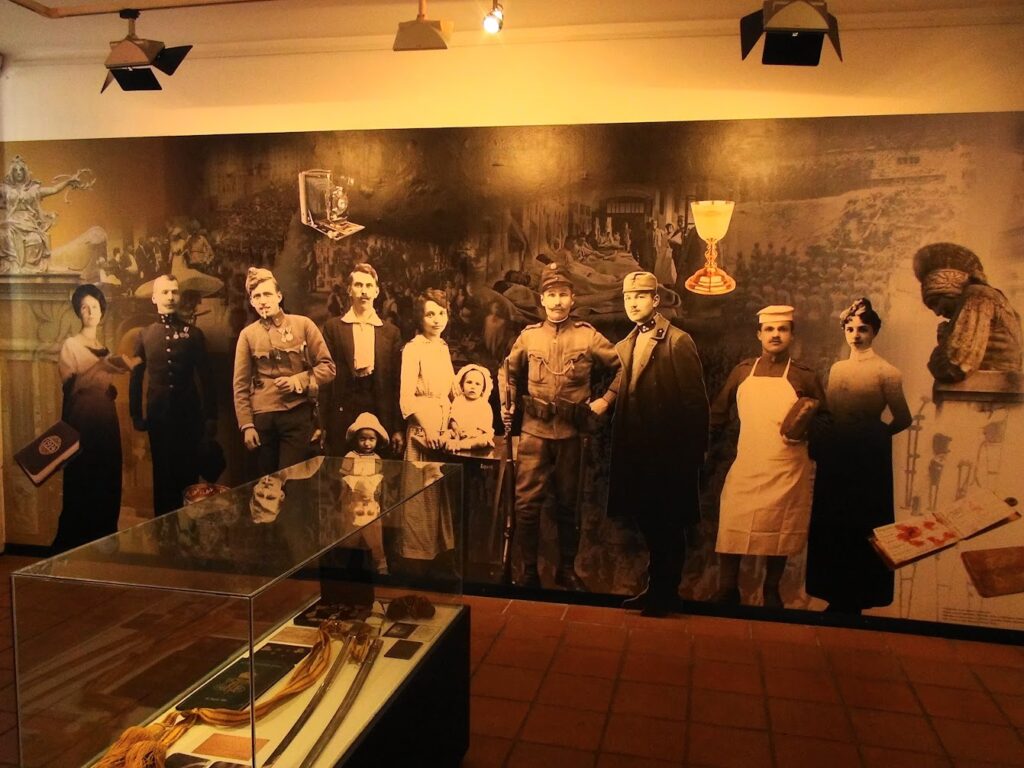
In Kobarid, the epicenter of the clashes, an impressive museum remembers the cruelties and pleads for peace and understanding.
But besides being the regional epicenter of WW1, Kobarid also became world famous because it is said to be the location of Ernest Hemmingway’s famous book “A farewell to arms”.
However, a debate still goes on whether Hemmingway was ever fighting in Slovenia. The fact that he arrived in 1918 suggests that this is not possible, because by then the Italians were already forced back from the Isonso (Soča) front, after the battle of Caporetto.
In reality Hemmingway was posted as an ambulance driver, behind the front line, in Schio (close to Verona). Some suggest that he visited the region after the war, because his book describes the environment quite accurately, unfortunately without mentioning locations. Still today locals however “prove” his presence with a picture of a young lookalike American soldier.

Despite being deployed in a rather safe area, the 19-year-old Hemmingway was wounded in a mortar attack on July 8, at the Piava river. The injuries on his legs were severe, but not life-threatening. Hemmingway was then decorated, and the incident gave him a certain heroic status, which he liked to cherish.
But, more important, the event triggered the birth of his famous book in which a fictitious American lieutenant, Frederick Henri (or Tenete), experiences the horrors of war around Kobarid and, likewise, gets wounded near the current village of Kanal.
Like his personage, Hemmingway is transported to a hospital in Milan where he meets the love of his live Agnes Hannah von Kurowsky who saved him from gangrene. After a short and intensive love story, they broke up, as she refuses to follow him back to the US.
In the book and a subsequent movie (1957) with Rock Hudson, Tenete falls in love with Caterine Barkley, played by Jennifer Jones. Von Kurowsky must have left a deep impression as Hemmingway features her later in several of his books. This dramatic love affair even has a “spin-off” movie in 1996, In love and war, featuring Sandra Bullock and directed by Richard Attenborough.
In 1961, the Pulitzer and Nobel price-winner, who survived this cruel and barbaric war, still died by a gunshot far away from Kobarid. This time it was his own decision.
His ultimate farewell to arms?
Leave a Reply