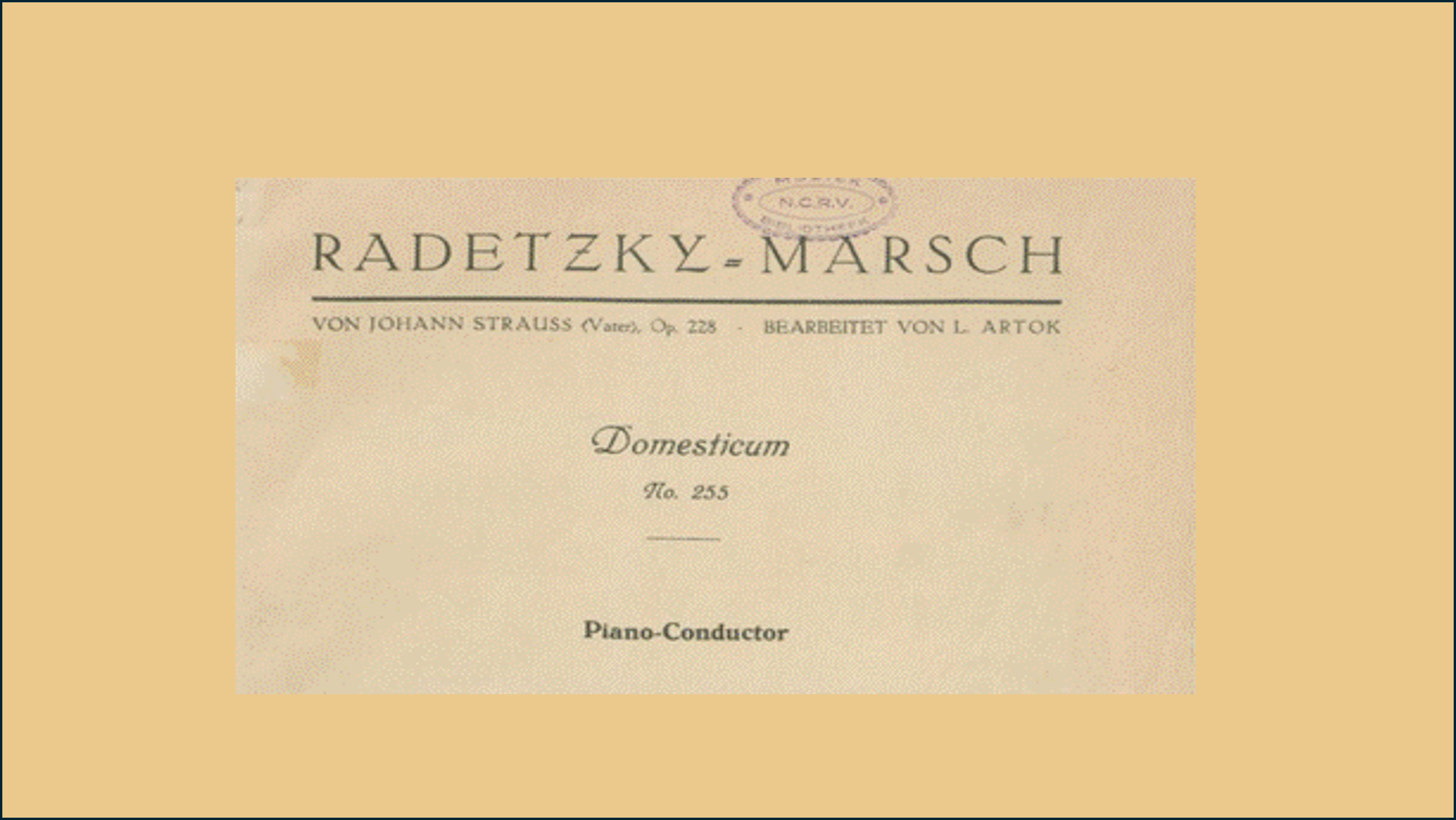

History teaches us that fame is volatile. The memory of the great statesman and brave battlefield-heroes who shaped modern Europe, only last a few generations. One moment you’re on, next minute you’re gone. But not so if your name is Josef Radetzky (1766–1858). His long career as Austrian high-ranked officer may have been impressive, but he would not be world famous without Johan Strauss’s “Radetzky March”.
Since 1946, this composition is played each New Year’s-day at the Vienna Philharmonics. And it is unique because, during part of the song the public is supposed to clap along. In any classic performance this would be considered blasphemy. But not in this case and that has a good reason.
A tradition is born.
The habit goes back to August 31, 1848, when the masterpiece was performed for the first time to honorRadetzky’s victory at the Battle of Novara. The then already 81-year-old Field Marshal had defeated the much larger army of the king of Sardinia, by the way with the help of the Slovenes of the 17th Infantry Regiment. It is told that his soldiers were singing a popular tune (the Tirenl lied) as they marched back to Vienna and that Strauss incorporated it into his composition. The many soldiers, present at the ceremony, were so enthusiastic that they spontaneously started clapping. This way a tradition was born, and it still lasts till today.
Radetzky was immensely popular amongst his soldiers because of his strategic mastermind and his personal courage on the battlefield. But even without his “own march”, he would still be remembered in Slovenia. In fact, the Czech born nobleman spend a substantial part of his life in Slovenia. The Slovens honored his memory with two public monuments and his own Slovenian composition (Radecki ima sivo glavo…) but the latter is seldom performed and not comparable to its famous Austrian counterpart.

Neuhaus castle burns.
Between 1807 and 1819, Radetzky lived in Tržič at the Neuhaus Castle with his Slovenian wife Francesca Romana von Strassoldo Grafenberg. At least when he was not again involved in one of the many battles for the Austrian Empire. When the city of Tržič burned down in 1811 also Neuhouse Castle was destroyed. Remarkable fact, even his later opponent Napoleon, whom he would beat in 1815, granted him 6000 gold coins for the reconstruction. Radetzky promptly employed as many locals as possible in the restoration thus providing an income for the desperate locals.
A new home in Tivoli park.
In 1853, Radetzky moved to Ljubljana, to Podturn in Tivoli. The mansion was bought by the Austrian Emperor Franz Joseph who restored it and gave it to his Field Marshall as a token of gratitude. He promptly redesigned the surroundings and opened the park to the public to show his commitment for the people of Ljubljana.

In 1857, the man who had survived so many battles slipped on his parquet floor, broke a hip, caught pneumonia soon after, and died the next year at the age of 91. The mansion changed owners again and gradually lost its grandeur when it became a shelter for the homeless. But all the time the park remained open for the public.
Radetzky’s statue overlooked the park since 1880, but in 1918 it was removed to get even with the Austrian regime. Till 2021 only the empty pedestal was left but then the Ljubljana city council decided to place a copy on the original spot.
A brave and good heart.
It mentions Radetzky’s quote before he engaged in the battle of Navara: “Soldaten, der Kampf werd kurtz sein”.
And so, the man who, even at a high age, went to the battlefield several times to serve his country, got his deserved place in the sun again. After all, in a time that rulers couldn’t care less about ordinary people, Radetzky was a rare exception.
So, the next time you hear Strauss’s earworm again, join in the clapping part. He deserves it after all…
Leave a Reply