
November,1921. Franc was driving back to Mirna pri Gorici. It was not an ordinary trip. The rickety car rattled over the cobbles and with every turn of the wheel his hart broke into pieces a bit more.

A few hours before he said goodbye to his daughter Marija whom he left on the Molo Audace in Trieste. On that quay she stepped on board of a huge ship which would bring her to Aleksandria in Egypt. There she would take up a job as a nanny in a wealthy British family. “Be careful”, he whispered while he wiped her tears away.
For a moment he thought he heard her laughter echoing among the stone terraces. But when he looked to his side, the seat was empty. He was really driving back alone. It started to sink in… Would he ever see her back ?
For this strong man, who hardly survived the trenches of WWI, it felt like he had failed to provide a decent life for his family. Conditions in this part of the country were harsh and people were struggling to meet ends. When he came back from the front his homestead was destroyed and he had to take a loan to start all over again. But it was very difficult to survive in this heavily damaged region. The new Italian government acted very hostile against the Slovenes.

While, before the war, he was able to sell his harvest to the Austrians, now the Fascist regime imposed all kind of limitations to Slovenes. And because there was hardly any industry left, no jobs were available.
Several times already he had angrily refused an offer of his brother, a merchant in Triest, to arrange a job for Marija in Egypt. He said it was very well paid, even 4 times more than in Slovenia, and many girls and women – nurses, nannies, governesses, cooks—had already found opportunities in Alexandria or Cairo. But when debts became unbearable, and bankruptcy loomed, Marija courageously stood up and decided; she would become an Aleksandrinka.
A lifeline from Egypt.
While this part of Slovenia became increasingly poorer, the opening of the Suez canal in 1869, made Egypt an economic hotspot. Especially Alexandria and Cairo became cosmopolitan cities. Wealthy traders, local Arabs but also British and French families flourished. Having a household staff was a must and “Les Slovenes” were seen as the ultimate status symbol. They were heavily valued because they were hardworking, submissive, clean and they learned languages fast, even English, French or Arab.
In 1940, about 7,000 Alexandrine women were in working in Egypt. Their commitment made a tangible difference back home: by sending money home, they helped many families survive. Even married women made the heartbreaking choice to leave their husband and sometimes new born children. They became “wet nurses”, breastfeeding other women’s children, to earn money and save their own children from starvation.
It was not the first time in history that Slovenes were moving abroad. The Slovene diaspora brought them to places all over the world, from Canada, Argentina, or to many countries in Northern-Europe. Especially in Cleveland in the US, a vibrant Slovene community was founded. They all have their individual stories and share the pain of leaving their beloved country behind. Still, the case of the Aleksandrinke stood out and was very controversial because it was women, not men, who took the lead.
A knife in the back.
Churches strongly opposed women leaving the traditional family behind for—God forbid—a Muslim country, not to mention the possible moral temptations. Indeed, the traditional family roles were substantially shaken. It was humiliating for men to admit depending on their wives’ earnings. Or to keep silent when rumors circulated about naïve women falling prey to local Arab men. Also, it did not help a lot that newspapers as Slovenski List wrote at that time about “Slovene women in places about which it is better for me to remain silent about”.
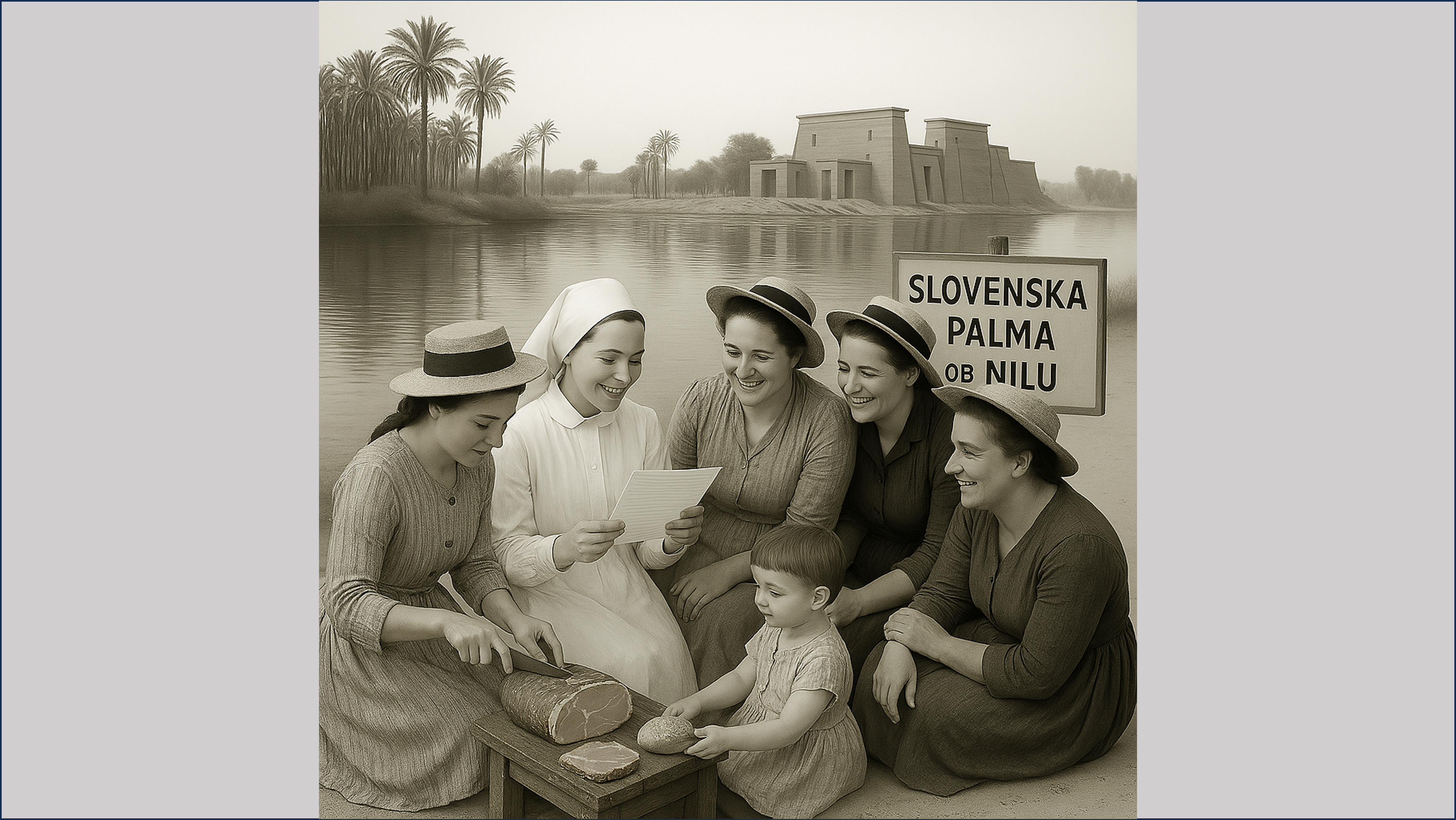
Reality, however, often differed. There was significant social control. Slovenes looked out for one another. They met regularly on Sunday when they were free, to exchange experiences. In the Slovenian society “Slovenska palma ob Nilu” they could speak their native language and gather some news from the homeland. And from 1908, local nuns cared for the women’s moral integrity by establishing Slovene schools, kindergartens, and even their own churches.
Despite this backlash, most Aleksandrinke were caring ladies, dedicated to their jobs. One of them, Milena Faganeli, became the nanny of former UN Secretary-General Boutros-Boutros-Ghali. And he spoke about her with very high regards and warm memories.
By the fifties and especially the late sixties, the exodus ceased as European families left Egypt amid rising nationalism after Nasser took power. Some left with their employers, others stayed and blended in.
But most women returned to Slovenia. However, they were not the same anymore as when they left. They were more independent and had gained new perspectives from the modern world where there were theaters, movies and parties. They went on trips with “their” families and were invited at receptions where they appeared with modern fashion and refined manners.
A culture shock, but finally also recognition.
No surprise—upon returning, they experienced severe culture shock and even hostility. Often they were ridiculed and treated as strangers by the very people for whom they had sacrificed so much. Even worse, locals called them unfaithful wives, bad mothers, or dishonorable daughters. And because of this, 90 years of labor-migration became a taboo in Slovenia.

Only in recent decades more attention has been paid to these courageous women. There is a small memorial museum in , a documentary about their lives in Egypt and a book : ”Aleksandrinke so prišle domov”.
I don’t know what happened to Marija and het father Franc. Did they ever see each other again? Was she treated well ? Did she remain poor? Is she the Marija who changed her name to Karolina Prah and became one of Egypt’s wealthiest women after she inherited about 70 million Dinar. Did I invent her, only to set the scene 😊?
You know… In fact all Aleksandrinke were “Marija”. Woman of courage, perseverance and sacrifice, but also of homesickness and struggle. But most of all, Marija symbolizes all women, who learned to stand up for themselves. In that sense it is fair to say feminism in Slovenia was born at the borders of the Nyle.
Leave a Reply